The text on screen in the opening seconds reads “…and you thought you needed a bigger closet,” and by the time it appears a woman is already hoisting a white cube organizer over her head and onto the shelf above her hanging rod. The 34-second reel from donna.found.it never leaves that one walk-in closet. Nothing gets torn out and nothing gets built in.
She slides the cube unit along the top shelf until it sits flush, with a row of empty hangers waiting on the rod underneath. Then she walks a tall arched mirror across the floor and leans it against the wall. Next to it she sets down a second cube unit, this one a freestanding tower two cubes wide, and nudges it back until it meets the baseboard.
The rest of the video is the filling in. On top of the floor unit she places a red pillow with the word love stitched across it in script, a small stacked box with bracelets set out in front of it, and a trailing green plant. Then the cubes get their contents, one thing at a time. A pair of red cowboy boots goes into the top compartment. Brown ankle boots take the cube below, and a pair of black boots goes in near the floor. Handbags get compartments of their own, so each bag sits upright with nothing stacked on top of it.
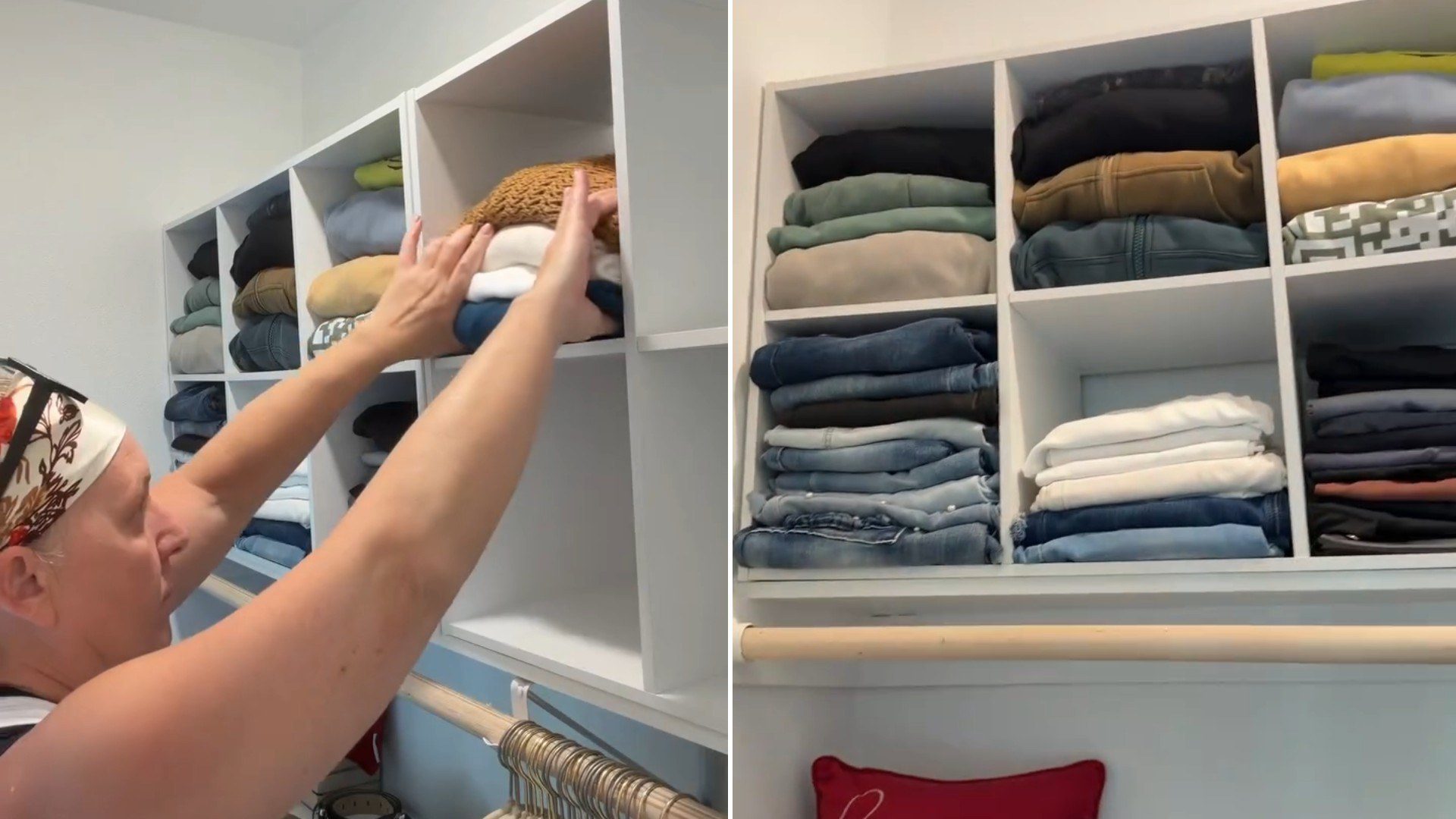
Up above the rod, she reaches into the shelf cubes and presses folded clothes into place. The stacks are grouped by color. Dark pieces sit together, greens and tans share a cube, denim has its own stack, and a pile of whites has another. Below them the rod fills with clothes on matching pale hangers.
The closing shots pan slowly across the result. There is a wall of folded stacks over the hanging clothes, a tower of boots and bags beside the mirror, and a navy cap resting next to the pillow. Her caption makes the same case as the opening text. She writes that the answer was smarter organizing and that a bigger closet was never required, and she tags the post for closet organizers, storage and organization.
The idea worth taking from her closet is where she put the cubes. Most reach-in and walk-in closets have a single shelf above the rod, and the space between that shelf and the ceiling usually holds one wobbly pile. A cube unit set on the shelf divides the same space into two rows of compartments. Each stack has walls around it, so pulling out one sweater does not bring down its neighbors.
A few checks make the project go smoothly. Measure the depth of the shelf and the height from shelf to ceiling before buying anything, because a unit that overhangs the shelf edge or will not clear the ceiling is no help. Look at how the shelf is supported, too. Folded denim is heavy, and a shelf resting on a couple of small brackets may need reinforcing before it carries a loaded organizer.
On the floor, her tower shows what to do with a bare stretch of wall. Boots and bags are awkward on ordinary shelves because they slump and pile up. Giving each pair or each bag one cube keeps its shape and makes it easy to see what you own. In a home with small children, a tall freestanding unit should be anchored to the wall with a furniture strap, since a loaded tower is a climbing temptation.
Her split between folding and hanging is also worth copying. Jeans and knits do well folded, and knitwear in particular can stretch at the shoulders on a hanger. Pieces that wrinkle go on the rod. Using one style of slim hanger for everything, as she does, lets more fit on the same length of rod.
Keep the stacks short. A cube packed to the top turns into the same mess as the old shelf pile, because the piece you want is always at the bottom. Four or five folded items per stack is a comfortable limit, and grouping by color the way she does means a missing piece is obvious at a glance.
None of it requires a contractor. What her half-minute video shows is a closet with the same walls, the same rod and the same shelf it started with, and room for everything once the unused space above the rod and along the floor is put to work.