A mom who posts as steph.agerton opens her reel in green scrubs, blow-drying her hair in a hallway, with one line of text across the screen: “I’m just wondering how a mom’s suppose to work a 9-5.” What follows is 45 seconds of her own days cut together, each clip carrying another item on the list of what that 9 to 5 has to fit around.
The list starts with the clock. “Drop the kids off at school by 8 am,” the text reads as she heads out the front door loaded with backpacks, two small children beside her. “Pick them up by 3 pm” comes next, over a shot looking down at the tops of two kids’ heads. Anyone who has held a job with standard hours can do that arithmetic without help: the school day is shorter than the workday at both ends.
Then the list keeps going. “Stay on top of school activities” runs over small children chasing across a sports field in low sun. “Meal prep, cook dinner, keep the house clean, do the laundry” covers three clips in a row: her at the stove beside a big stockpot, on the couch with a pile of laundry, then bent over the drawers under a bunk bed. “Drive to extracurricular activities” plays over a child walking a balance beam in a gym. “Climb the corporate ladder” lands on a selfie shot of her at work, in navy scrubs and a patterned scrub cap with a badge clipped to her top.
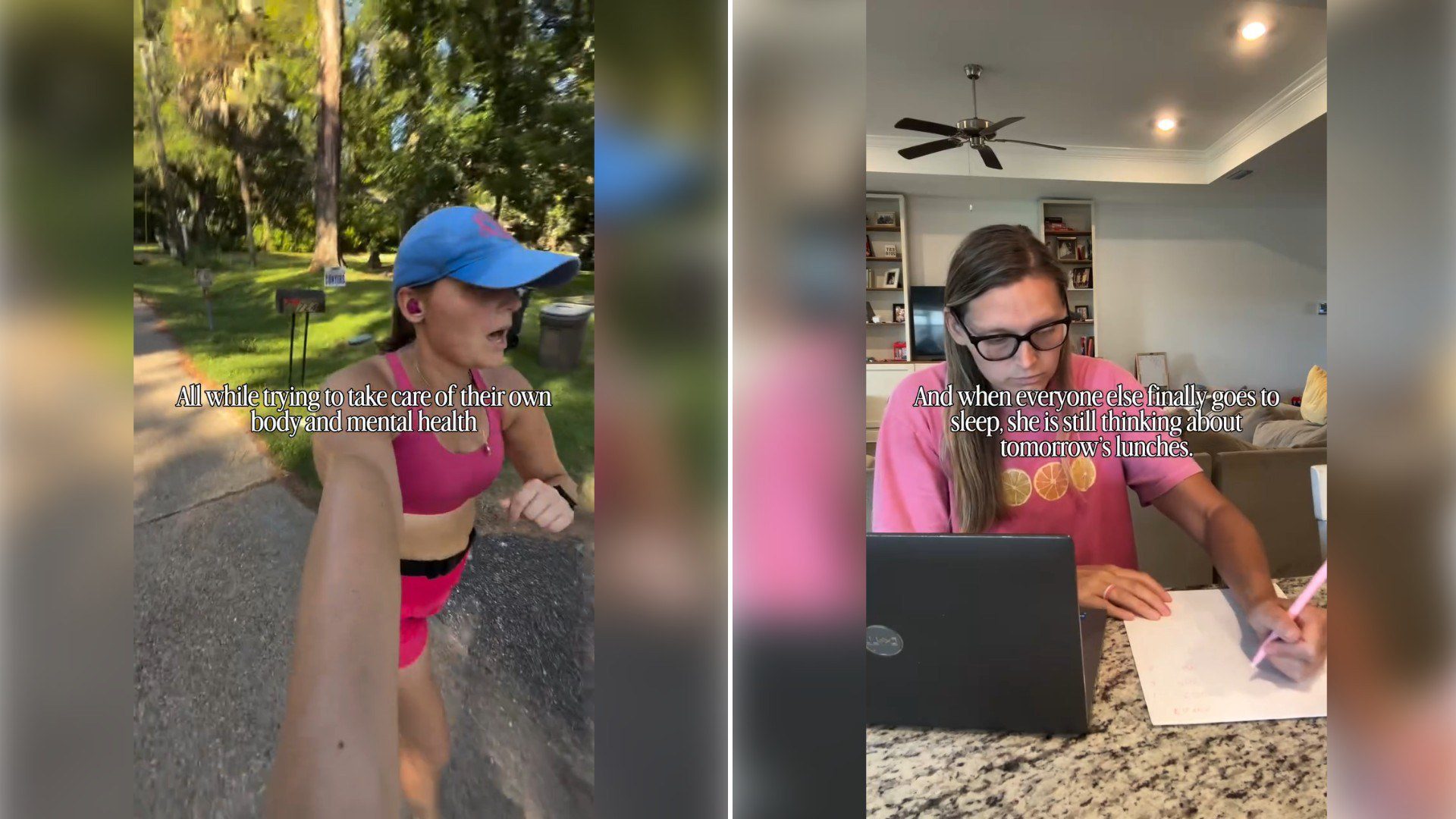
Two of the lines hit harder than the rest because of how plainly they are put. “Save sick days for when the kids are sick” sits over two children walking away from the camera down a long pier. “Be a good friend, good daughter, a good partner” appears while she bends over a backyard flower bed. And then, over footage of her out for a run in a ball cap: “All while trying to take care of their own body and mental health.”
That is where the reel turns from a list into an argument. “And then people wonder why so many mothers are exhausted,” the text reads as she laughs with a hand pressed to her forehead. The next lines come while she rubs the back of her neck in a blue floral dress: “Not because they are weak. Not because they are lazy. But because they are carrying responsibilities that would overwhelm most people.”
The camera moves in close on her face, eyes red, as she wipes at her cheek. The line on screen: “The truth is most mothers don’t get to clock out.” She is back in scrubs in a parking lot for the next one, about the second shift that begins when the work day ends, and then at the kitchen counter with a laptop and a pen for the part many parents will recognize: “And when everyone else finally goes to sleep, she is still thinking about tomorrow’s lunches.” On screen she is loading two kids’ backpacks, with matching water bottles lined up on the dining table.
The last stretch names what is running through her head. “The drs appointment. The permission slip. The grocery list. The bills. The birthday coming up.” She is standing in a store aisle turning a toy over in her hands. Then: “The child who’s been unusually quiet. The child who’s struggling,” over her leaning in beside a little boy at a table. The final line arrives as she stoops to gather toys off the living room rug: “That’s the invisible work that nobody applauds.”
Her caption speaks straight to the person watching. “You were never meant to carry all of this and make it look easy,” she writes. She calls the mental load of motherhood heavy “because so much of it is invisible,” and spells out what she means: “the appointments, the school things, the groceries, the laundry, the schedules, the meals, the emotions, the constant remembering of what everyone needs and when they need it.” She also names the guilt that rides along with it: “somehow, while carrying all of that, we convince ourselves we’re still not doing enough.”
Her answer to that guilt is the most practical thing in the post. “Your kids aren’t keeping score of the laundry piles or how many homemade dinners you made this week,” she writes. “They’re going to remember you.” She lists what she thinks they will hold on to instead: “The way you showed up. The way you loved them. The way you made ordinary days feel like home.” She closes with “if you’re feeling behind today, remember: you’re probably carrying more than you’re giving yourself credit for,” and asks viewers to send the reel to a mom who needs the reminder.
The reel offers no fix, and she does not claim to have one. What it does hand over is a usable inventory. Her on-screen list holds roughly a dozen separate jobs, and most of them never show up on a calendar. In a household where one person is carrying most of them, writing the list down the way she does, line by line, is a concrete first step. A task that lives only in one person’s head cannot be handed to anyone else.
It helps to split the list the way her video does. Some items are fixed by the clock, like the 8 am drop-off, the 3 pm pickup and the drive to activities, and those can be traded or alternated between the adults who are able to do them. Some are recurring chores, like dinner and laundry, which can be assigned outright instead of “helped with.” And some are pure remembering: the permission slip, the appointment, the birthday coming up. Those are the ones she says follow a mother to bed, and they are the easiest to move onto a shared calendar or a list on the fridge so that the remembering stops being one person’s job.
Her sick-day line deserves a conversation of its own in any home with two working parents. Whose leave gets used when a child is home from school, and is that decided each time or simply assumed? Asking the question out loud once is easier than resenting the answer all year.
Her caption also applies on the nights when the list wins. The laundry pile and the count of homemade dinners are exactly the things she tells mothers to stop scoring themselves on. Tomorrow’s lunches still have to get made. The standard for everything else can drop a notch, and by her account, the kids will not be the ones keeping track.