For the better part of a decade, the recipe for a “good” kitchen renovation was almost formulaic: white or pale gray cabinets, a cool-veined quartz countertop, and a subway tile backsplash that matched nothing so much as it politely disappeared. That formula is losing its grip. In Houzz’s 2026 Kitchen Trends Study, wood cabinetry pulled ahead of white for the first time in years, chosen by 29 percent of renovating homeowners compared to white’s 28 percent, a five-point drop for white in a single year. Meanwhile, industry spending-trend data originally referenced from Angi’s State of Home Spending Report found that 22 percent of homeowners planning a kitchen renovation intend to install continuous countertops, where the counter and backsplash are cut from the same slab so the two surfaces read as one unbroken plane, and another 25 percent are building their renovation around natural wood tones. Something in the American kitchen is warming up, quite literally, and it is worth understanding why before you pick up a paint chip or a countertop sample.
The Kitchen Is Trading Its White-and-Gray Uniform for Warmth
You have probably felt this coming even if you couldn’t name it. The crisp, clinical kitchen that dominated renovation photos for years is starting to feel a little cold, a little rented. Houzz’s data backs that instinct up in granular detail: medium-toned wood is now the single most popular cabinet finish at 15 percent, with light wood at 11 percent and dark wood at 3 percent, while off-white cabinetry holds steady at 15 percent. Even the smaller numbers tell the story. Green cabinetry now narrowly outpaces gray, 6 percent to 5 percent, which is a modest shift on its own but part of a larger pattern away from cool, neutral palettes and toward colors and materials that feel grounded and lived-in rather than showroom-sterile.
This isn’t just about what looks good in a photo. Angi co-founder Angie Hicks has noted that “aesthetic upgrades are always popular, but this year we’re seeing a lot of functional upgrades as well,” and that framing matters here. Wood cabinetry and natural stone aren’t just prettier than a flat white door front, they also tend to hide the everyday evidence of a kitchen actually being used, from fingerprints to water spots to the general scuffs of a family cooking dinner five nights a week.
What a “Continuous Countertop” Actually Looks Like
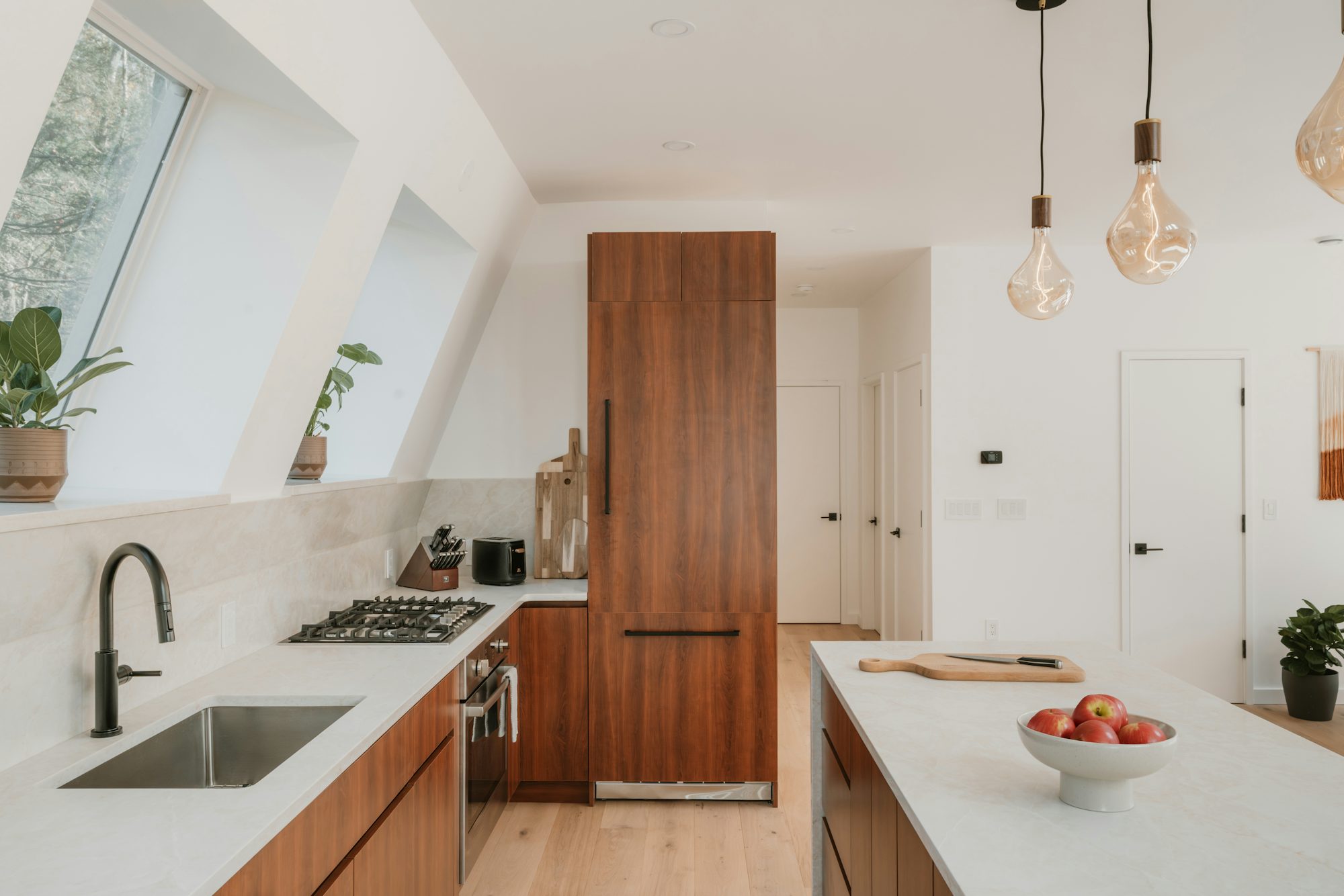
If you haven’t renovated a kitchen recently, the phrase “continuous countertop” might not mean much yet, but you will be seeing it everywhere soon. The idea is straightforward: instead of a countertop in one material and a backsplash in another, often a contrasting tile, the counter and the wall surface behind it are fabricated from the same slab. Sometimes that means the material runs a few inches up the wall in a low-profile splash. Increasingly, it means a full-height slab backsplash that turns the entire cooking wall into one continuous piece of stone or engineered material, with no grout lines to interrupt the eye.
Common materials for the look include marble, engineered quartz, quartzite, concrete, tile, and wood, and the appeal is largely about visual calm. A kitchen with fewer material transitions and fewer seams simply reads as more restful, which is part of why this trend is showing up alongside the broader move toward warmer, less busy kitchens rather than against it. Separately, Houzz’s research on backsplash choices found that among homeowners who chose a slab backsplash rather than tile, a share that rose to 28 percent from 24 percent the year before, 39 percent used engineered quartz and 33 percent used quartzite. Those two materials are popular for a practical reason: they resist staining and etching far better than marble does, which matters enormously on a surface that sits directly behind a stovetop.
Why Wood Is Elbowing Out Painted Cabinets and Cool Grays
Painted cabinets have a real weakness that natural wood doesn’t share: paint chips, scuffs, and eventually needs to be redone, especially on high-traffic pieces like an island or the cabinets flanking a range. Natural wood ages instead of failing. A dent or a water ring becomes part of its character rather than a flaw that needs touching up, and that durability is part of why homeowners are gravitating back toward it after years of white and gray dominance.
There’s also a timelessness argument that matters more than it might seem. A cool gray kitchen photographs beautifully, but gray as a color trend has a shelf life, and homeowners who chased it hard in the past several years are now the ones staring down a kitchen that already feels dated. Wood tones, particularly the warm medium tones currently leading Houzz’s data, have historically aged more gracefully because they’re tied to a material rather than a color moment. If you’re renovating with resale in mind as much as your own enjoyment, that staying power is worth weighing seriously against whatever is trending hardest on your social feed this month.
The Real Cost of Going Continuous
It’s worth being honest about budget before you fall in love with a full slab backsplash. A continuous countertop requires more material than a standard setup, since you’re buying enough slab to cover both the counter run and the wall behind it, and fabricators typically charge extra for the cutting, seaming, and installation involved in a tall backsplash. According to Houzz’s renovation spending data, a major kitchen remodel now carries a median cost of $55,000, climbing to $75,000 for larger kitchens over 250 square feet, while smaller kitchens under that threshold land closer to $46,000. Minor updates, by contrast, land at a median of $20,000.
That gap between a full remodel and a minor update is exactly where the continuous countertop trend gets interesting for most homeowners, because you don’t need to spend at the top of that range to get the look.
How to Get the Look Without Gutting Your Kitchen
You don’t have to rip out your entire kitchen to borrow from either trend, and honestly, you shouldn’t unless your kitchen genuinely needs it. If you love the continuous countertop look but not the price tag of redoing your whole cooking wall, concentrate it in one high-impact zone instead. A waterfall edge on an island, where the countertop material wraps down the side panel, delivers the same unified, seamless feeling as a full slab backsplash at a fraction of the material cost, because you’re only extending the surface a few extra feet rather than several. Alternatively, run the slab up as a backsplash behind just the range or cooktop, the one spot in the kitchen where people’s eyes naturally land, and leave the rest of the room in standard tile.
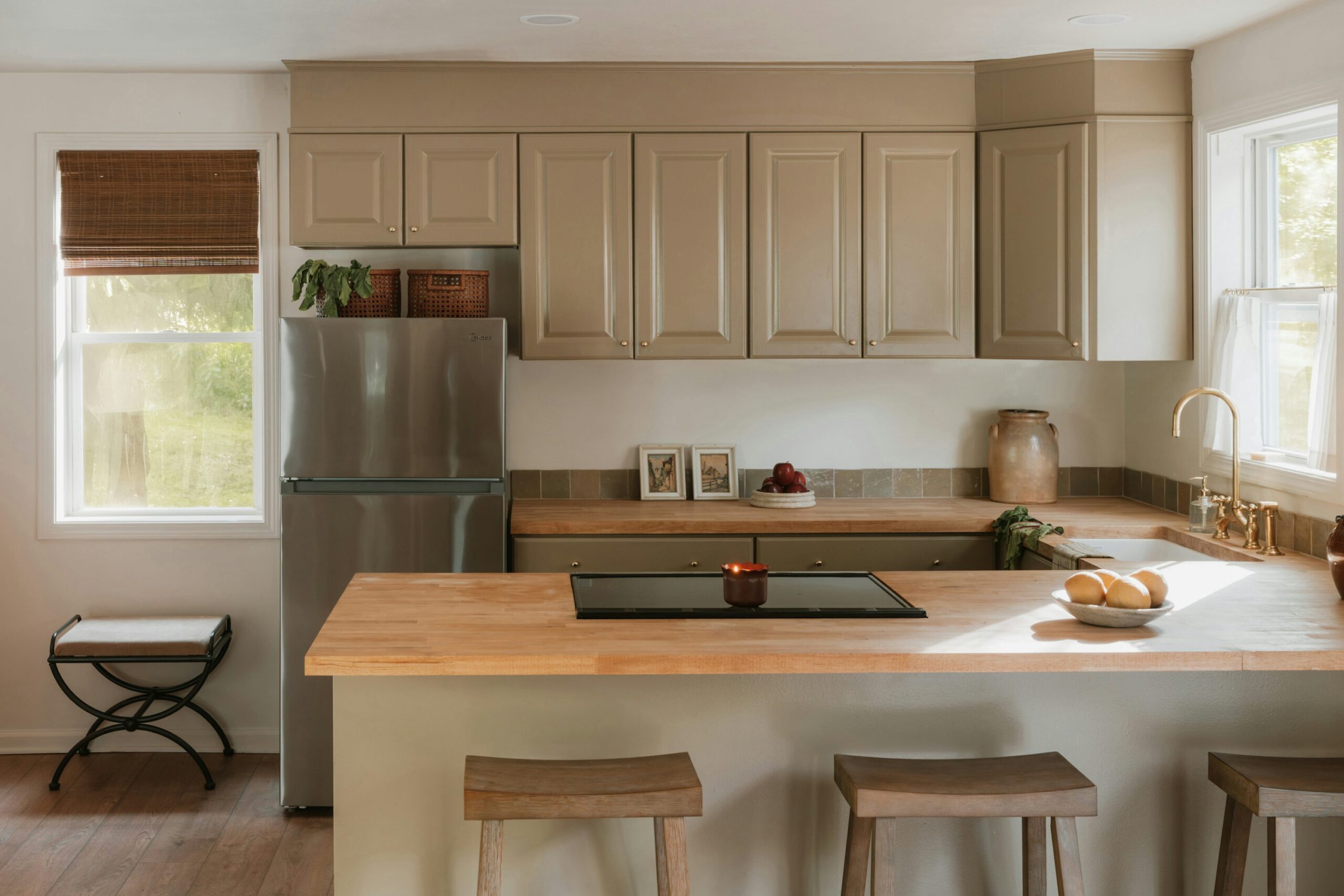
For the wood-tone shift, you have even more room to be strategic. Refacing or refinishing your existing cabinet boxes with a wood veneer is dramatically less expensive than replacing them outright, and it delivers most of the visual warmth homeowners are chasing. If a full refacing job still feels like too much, swap only your lower cabinets or your kitchen island to a wood finish and keep your uppers in white or off-white, which mirrors exactly the kind of mixed-tone kitchens showing up in current renovation photos and keeps your budget in check. Open wood shelving, a wood range hood surround, or even wood bar stools can introduce the tone without touching your cabinet boxes at all. And if you’re set on the engineered quartz or quartzite that’s dominating the slab-backsplash category, ask your fabricator about remnant pricing, since a small accent zone behind the cooktop uses far less material than a full kitchen countertop and can often be cut from an offcut piece for meaningfully less than a full slab order.
What’s really happening in kitchens right now isn’t a swap of one trend for another so much as a quiet rejection of the idea that a kitchen needs to look like a showroom in the first place. Continuous countertops and natural wood both do the same underlying job: they remove the visual noise of too many competing materials and replace it with something that feels intentional and calm, the kind of room you actually want to cook and gather in rather than one you’re simply maintaining. That’s a better standard to renovate toward than whatever color happens to be trending, and it’s one your kitchen will hold up to for a lot longer than a coat of paint ever could.