The apartment starts out exactly as forgettable as countless rentals before it, a plain hallway, a living area with builder-basic white walls, dated fixtures, nothing that suggests anyone would look twice. That is precisely the point of the video. The creator walks through the space as it was, unremarkable and a little tired-looking, before diving into the dramatic overhaul that turns it into something that looks pulled straight out of a moody, book-lined dark academia fantasy.
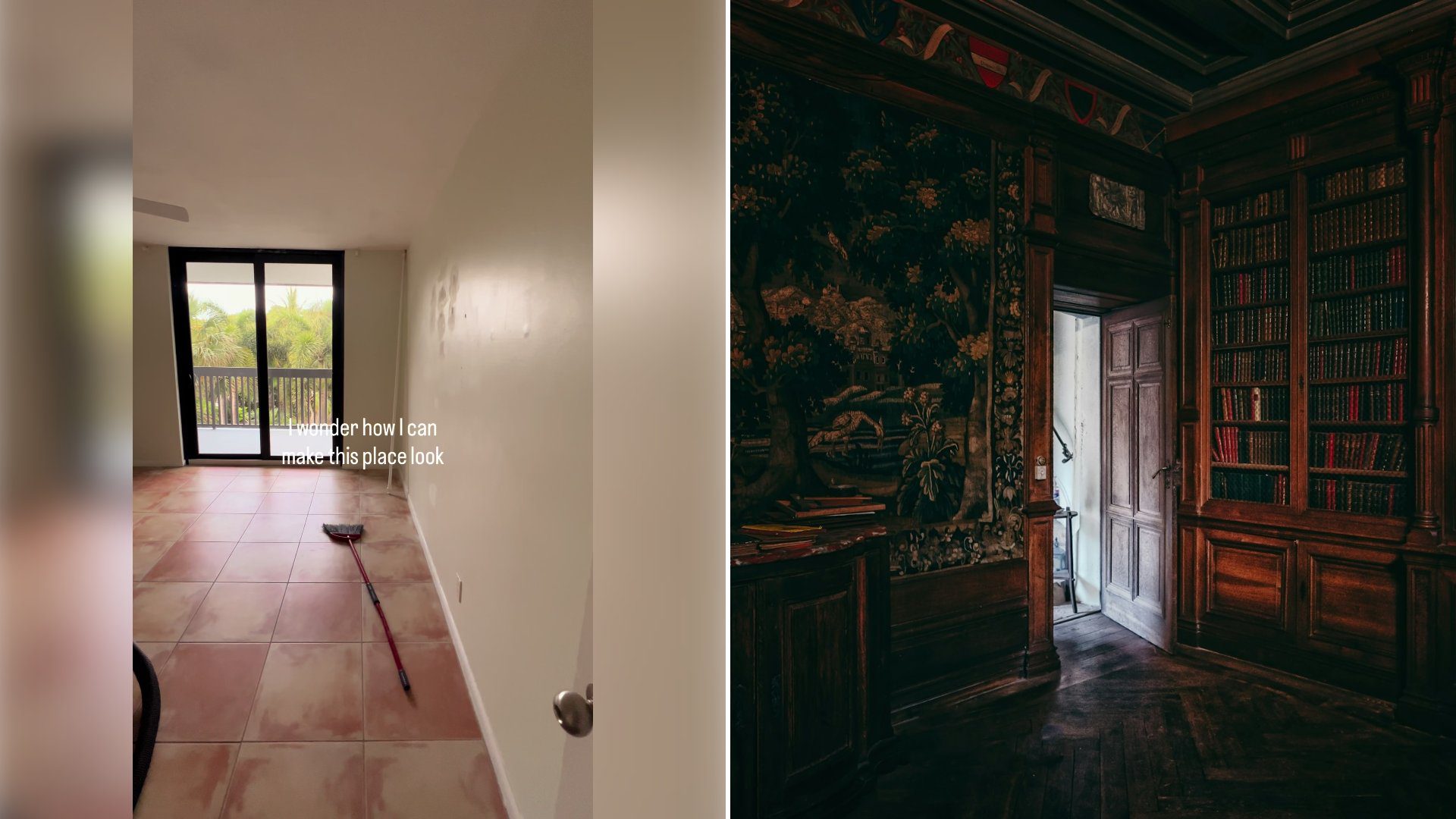
Creator @moodywhimsicalforest leans into deep, saturated paint colors, layered textures, and vintage-inspired decor and furniture choices to pull off the shift, and the before and after contrast is jarring in the best way. What reads as a flat, characterless hallway in the opening shots becomes rich and atmospheric by the end, proof that the bones of a space rarely dictate its ceiling the way people assume they do.
@moodywhimsicalforest
Interior designers have long pointed to lighting and color as the two most transformative, lowest-cost levers available in any renovation, and this transformation leans hard on both. Dark, saturated wall colors, the kind used throughout this makeover, absorb rather than bounce light, which can make a space feel intimate and enveloping rather than cold, provided the room has a reliable secondary light source to keep it from feeling cave-like. Designers typically pair deep wall tones with warm-temperature bulbs and layered lighting, floor lamps, picture lights, and sconces in addition to any overhead fixture, specifically because a single harsh overhead light reads very differently against a dark wall than it does against a plain white one.
Color theory also explains part of why the dark academia aesthetic photographs and feels the way it does. Deep greens, browns, burgundies, and near-blacks are associated in design psychology with a sense of groundedness and focus, which is part of why the look is so often paired with books, brass hardware, and old-world furniture silhouettes; the palette itself signals history and intellect before a single prop is added. That same psychological weight is exactly what made the original plain white hallway feel so forgettable in the first place. Builder-grade white is a neutral default, designed to offend no one and excite no one, and it rarely creates the kind of emotional pull that a deliberately chosen, saturated color scheme does.
This kind of transformation has also become a defining feature of renter-focused design content, since so many of the techniques shown, paint, furniture, textiles, and decor, are fully reversible and do not require permission from a landlord or a major structural budget. That accessibility is a big part of why before and after apartment transformations consistently perform well online; viewers are not just watching a pretty room, they are watching proof that a rented, rule-bound space can still be meaningfully personalized without violating a lease.
There is also a practical lesson buried in the dramatic reveal for anyone staring at their own plain apartment feeling stuck. The instinct when a space feels blank is often to assume it needs an expensive renovation to feel finished, when in reality color commitment and a cohesive style point of view can do most of the heavy lifting. A small, consistently styled space with a strong identity will almost always read as more intentional, and more impressive, than a larger space filled with a mismatched collection of furniture and no unifying color story.
What lingers after watching is not just the aesthetic payoff but the reminder that most rental apartments are intentionally neutral precisely so they can become a blank canvas. This creator simply refused to leave it blank, and the result is a space that looks like it was always meant to feel this way.
More from Decluttering Mom
- Creator Shows How To Make a Bed Look Like a Hotel Showroom With a Few Specific Folding Techniques and Explains Where She Picked Them Up and Why It Matters
- Homeowner Deep Cleans Ornate Woodwork in Her Century Old Impulse Bought House and Shows How Much Dust and Debris Decades of Neglect Left Behind in Every Groove
- Mom Says After Twenty Years in a Big Family Home She Chose To Downsize and Simplify Her Life and Explains What She Let Go Of and What She Kept