

Most decluttering advice tells you to get rid of the broken, the stained and the long expired. The creator behind @AtoZenLife has a tougher message. She says it is time to let go of perfectly good stuff too, even when it feels wasteful, and she opens her talk with a gadget she bought and never used.

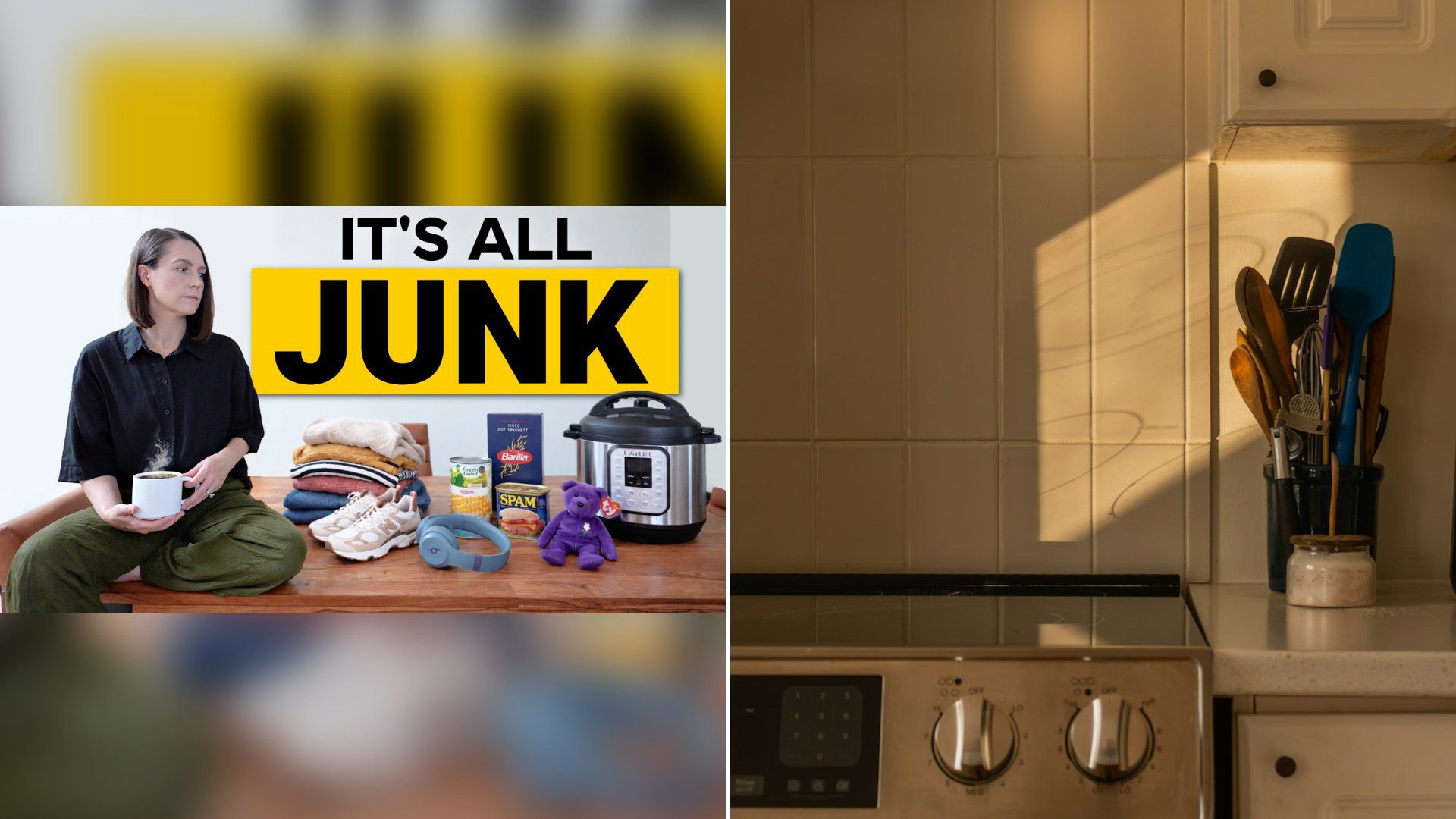

Her thesis is simple. She says some things cost us a whole lot more when we keep them. The real shift, in her view, comes from asking why we buy and keep things in the first place, not from asking whether an item sparks joy.
The Deli Meat Maker Under the Towel
In her kitchen, she reveals a gadget hiding under a hand towel, a deli meat maker. By her purchase history, she says, it has sat unused for 128 days, which is about four months. She calls it an impulse buy that came after ten years of minimalism.
She explains why she bought it. Her family had cut back on deli meat, which limited what she could pack in her boys’ school lunches. The ad for the gadget seemed like a fix, and she says it was also a way to ease some mom guilt. Then the guilt flipped. Now she felt guilty for not using the thing.
She jokes that the box says to say hi to your new life, and that it should really say to say hi to your new lies. Within a week, she says, she realized the gadget was too much trouble and wanted to return it. Her husband swore he would use it all the time. In the end he admitted he would not.
So why did she keep it? She names two reasons, the thought of needing it just in case and guilt over the wasted money. Her point is that the money is actually wasted when we purchase the item we do not use, not when we finally let it go. The gadget cost about $30 and added nothing to her life, so she decided that $30 was simply the price of a lesson about gimmicky gadgets.
She also offers a rule of thumb from the minimalist world, the 90/90 rule. If you have not used something in the past 90 days and have no plan to use it in the next 90 days, it can go. She says to exclude seasonal things such as winter coats and holiday decor.
Food That Will Never Get Eaten
Her next category is expired and unused food, and she admits it is touchy. She is frugal and hates waste herself, but she says that as a busy mom with kids who have different tastes, you have to accept when some food will never be eaten. Her example is an opened package of dry Korean pancake mix, used once or twice, that the kids did not like and that was past its best by date of February 2024.
She shares two mindset shifts. First, someone else might use the item more than you, so give unexpired food to friends or a food pantry. She mentions moms who donate extra Halloween candy to local firefighters. Second, she suggests treating unwanted or expired food as information. It tells you something about what your family really eats, and that makes meal planning smarter next time.
Books, Magazines and the Three U’s
Next come books, magazines and cookbooks. She sorts them with what she calls the three U’s, which are unread, unfinished and unwanted. Her examples include a library copy of Hidden Figures that she says was heavy on math and engineering and made her feel dumb, so she decided to skip the book and see the movie. She also describes a Jane Austen novel from a neighborhood little free library that she returned unread after months.
She says she used to power through books to prove something, but now she accepts that a book can simply be a mismatch of time, energy or interest. Her habit now is to borrow books and audiobooks from the library first and buy only the ones she wants to reread.
The Valuable Junk Trap
The longest part of her talk covers things that seem valuable. She says she has made tens of thousands of dollars selling her clutter online after decluttering most of her belongings, but she only sells when it is worth her time. She points to two ideas from behavioral thinking. One is loss aversion, the notion that a loss hurts about twice as much as the same gain pleases. The other is the endowment effect, which means we value things more simply because we own them.
Her advice is to set boundaries and deadlines. A boundary can be about money, such as deciding that anything worth under $50 is not worth the effort of selling, or about space, such as keeping only what fits in a certain area of the home. She contrasts a green glass vase worth maybe $5 to $10, which she donated, with vintage audio equipment left by a previous owner of her home that sold for $1,200 and $1,500.
Clothes You Do Not Enjoy Wearing
Finally, clothes. She describes a $140 linen maxi dress she bought about four years ago because linen was trendy in minimalist circles, along with thrifted skinny jeggings that cost about $5. She says she is really more of a gardening in her husband’s old clothes person, so the dress was a purchase for a fantasy version of herself. She now prefers cozy, relaxed fits. Her three questions are whether she would buy it again today, whether she is honoring it or afraid to let go, and whether someone else could use it more.
Putting the Ideas to Work
You do not have to agree with every point to borrow a few of her tools. Here is how to try them at home.
Start with one shelf. Pick a cabinet or drawer that holds gadgets, and pull out anything you have not touched in 90 days. Be honest about your plans for the next 90. If an item has a use but you simply forgot it exists, put it somewhere you will see it. If not, set it aside.
Count the real cost. The price tag is already spent. Keeping a gadget that never gets used adds another cost, which is the space it takes and the small guilt every time you see it. Treat the purchase as tuition, learn from it and move on.
Give it a second life. Wrap up the unopened pantry items and take them to a food pantry before they expire. Offer the gadget to a friend who might use it, or post it for sale if it is worth your time. If the item is worth under your personal minimum, donate it.
Use the library first. Before you buy a book, borrow it. If you find yourself reading it again and again, buy your own copy.
Ask the three questions. Would I buy it again today? Am I keeping it out of respect or fear? Could someone else use it more? The answers are usually clearer than you expect.
A Lighter Way to Let Go
Her message may sound radical, but it comes down to kindness toward yourself. You are allowed to learn from a mistake without punishing yourself for it. A deli meat maker under a hand towel is not a failure, it is a $30 lesson that can free up a corner of your kitchen and a bit of your mind.