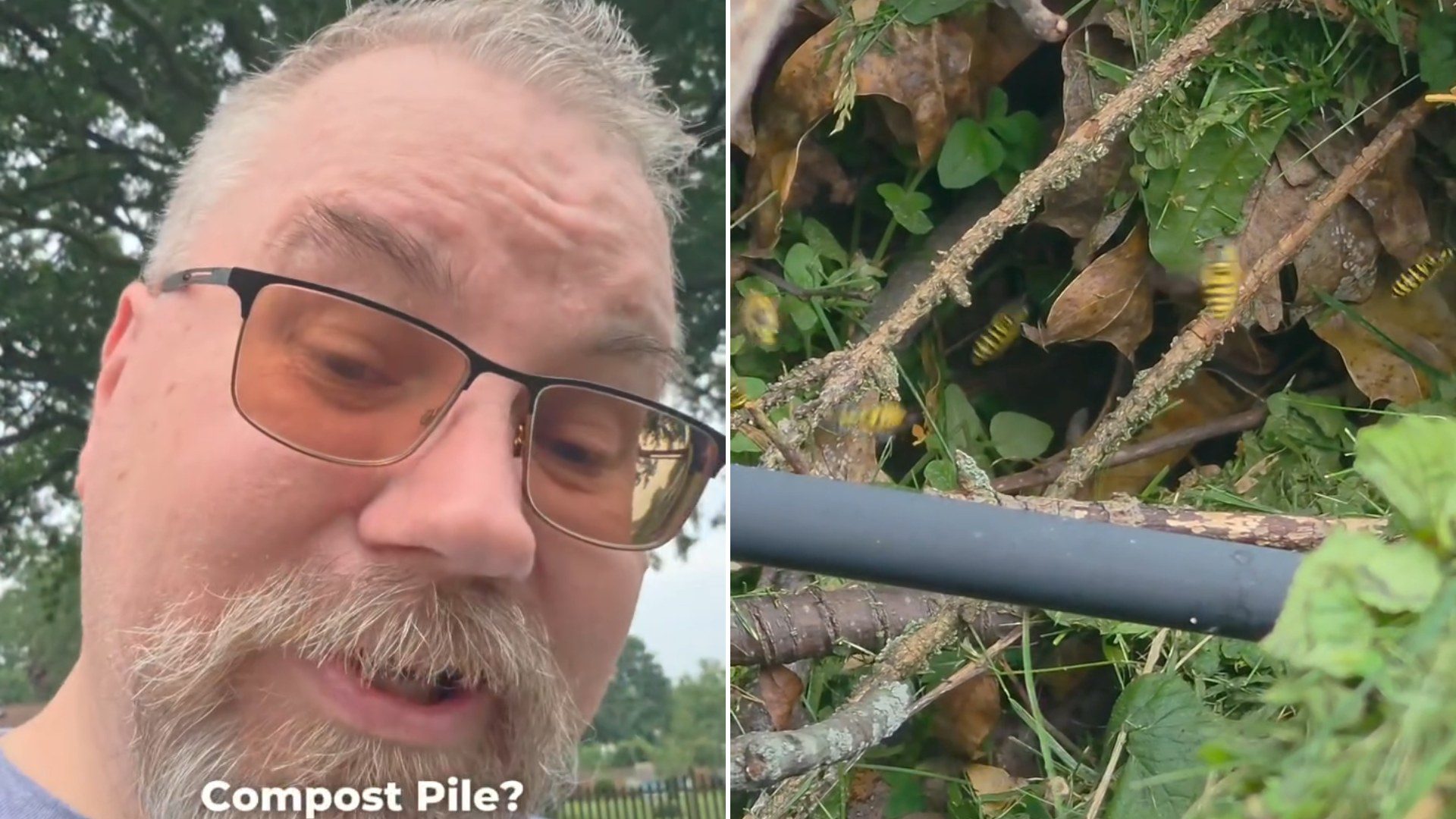
A homeowner discovered an entire yellow jacket nest had been building inside her backyard compost pile all summer without her noticing, according to her own Instagram post. The video, shared on her account, shows the moment the nest becomes visible within the pile, a reminder that compost bins sit near the top of the list for where these pests set up unnoticed each year, especially once the weather starts to turn and colonies reach their largest size of the season.
Compost piles offer nearly everything a yellow jacket colony needs. The loose, insulated material stays warm from decomposition, holds its shape well enough to tunnel through, and sits undisturbed for weeks at a time in most backyards, which is exactly the combination of shelter and quiet that makes it attractive to a queen scouting a nest site in spring.
The nest can grow for months before anyone spots it. A colony that starts with a single queen in early spring can expand to thousands of workers by late summer, all while staying hidden inside a pile that’s rarely turned over or disturbed from the same angle twice, which is how a nest can reach full size without a homeowner noticing anything until much later in the season.
Late summer and early fall are when colonies peak. Unlike honeybees, yellow jacket colonies don’t survive the winter as a group; only new queens live through to the following spring, which means a colony spends the whole warm season growing toward its largest population right before it dies off. That growth curve is why a nest that was easy to miss in June can suddenly seem impossible to ignore by September.
They’re easy to mistake for a less aggressive insect. Yellow jackets are often confused with bees, but they’re wasps, capable of stinging repeatedly without losing their stinger, and a ground- or debris-based nest like one built into a compost pile tends to produce a faster, more defensive response to disturbance than a typical bee colony would.
Increased activity around the pile is usually the first sign. A steady stream of insects flying in and out of one specific spot, rather than a few wasps passing through, generally means a nest has already been established rather than one just starting to form.
Vibration and disturbance are what trigger a defensive response. Yellow jackets nesting underground or inside loose material like compost are especially reactive to footsteps or a pitchfork breaking into the pile near the entrance, which is when most backyard stings happen, not from wasps simply flying nearby.
The right move after spotting one is to back away, not investigate further. Once activity around a pile suggests a nest is there, the safest response is to stop turning or working the compost, keep kids and pets clear of the area, and avoid using sprays or hoses to try to flush it out, since a disturbed nest can send workers after anyone nearby, not just whoever triggered it.
Professional removal is the safer call for an established nest. Once a colony has grown large enough to be spotted from a distance, treating it without protective equipment and the right approach carries real risk, and pest control professionals generally recommend calling in help rather than disturbing a mature nest directly, particularly one built into material that’s hard to see all the way through.
Regular turning is the main prevention step for next season. Compost that gets turned every week or two stays too disturbed for a queen to settle into undetected, while a pile left alone for long stretches, especially one that’s been sitting since the previous fall, gives a colony the exact conditions it needs to start without interference.
What’s actually in the pile plays a role too. Yellow jackets are drawn to protein as much as sugar, which makes a compost pile that includes meat scraps, dairy, or food waste more attractive to a scouting queen than one built purely from yard trimmings and vegetable peels, on top of the warmth and shelter the pile already provides.
The pattern behind discoveries like this one is less about any single homeowner missing something obvious and more about how well a compost pile hides what’s happening inside it, right up until the colony is large enough that there’s no missing it at all.