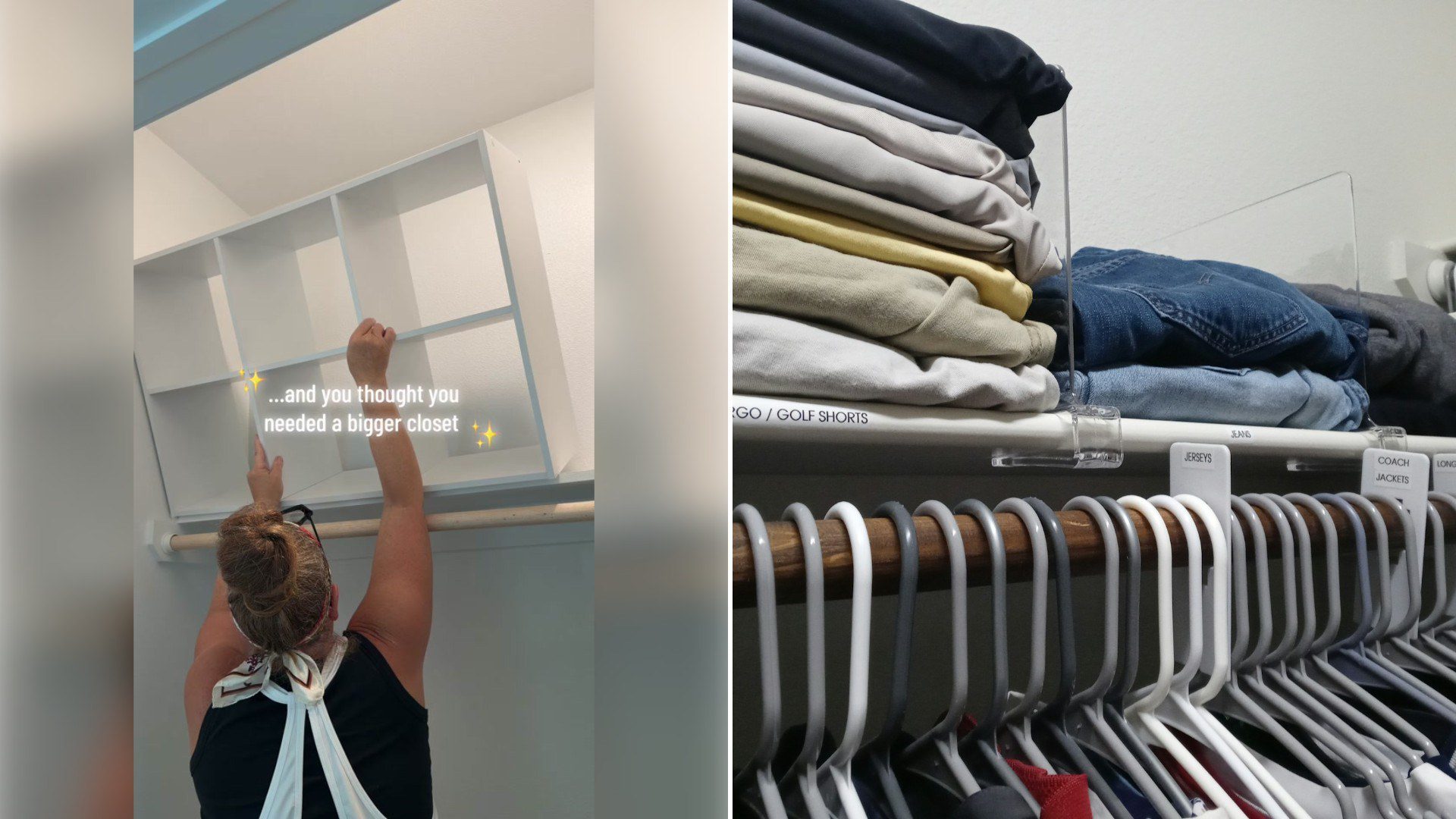
A creator posting under the handle shamrockd888 demonstrated adding modular cube storage inserts into her existing closet, step by step, dramatically increasing how much it could actually hold without any renovation, expansion, or move to a bigger space.
@shamrockd888 #closetorganizationhacks #closetorganizationideas #closetorganization #cubestorageorganizer
The caption delivers the real punchline: “…and you thought you needed a bigger closet.” It’s a simple, low-cost fix aimed squarely at anyone who’s ever assumed the solution to closet overload was more square footage rather than better use of the square footage already there.
Cube inserts and modular dividers are a fairly common closet-organizing tool, but the before-and-after framing here does a good job of showing just how much usable space gets wasted by loose stacking and ungridded shelving, rather than any real shortage of physical room.
For anyone eyeing a bigger closet or a home addition purely to solve a storage problem, this is a useful reality check: a lot of what feels like a space shortage is actually an organization shortage, solvable for a fraction of the cost of adding square footage.
There’s a specific kind of satisfaction that comes from watching a storage problem get solved with a fifty-dollar cube organizer rather than a five-figure renovation, and that gap is exactly what makes a video like this one so compelling to watch. Most people don’t actually enjoy thinking about closet renovations; they think about them because the alternative, living with an overstuffed, chaotic space, has become frustrating enough to justify considering something drastic. Seeing a modest, inexpensive fix undercut that drastic assumption entirely tends to land as genuinely satisfying, almost like catching yourself about to overpay for something that had a much simpler solution all along.
Loose stacking is probably the single biggest offender when it comes to wasted closet space, and it’s worth understanding exactly why. A stack of folded sweaters without any structural support tends to lean, slump, and require constant restacking, which means the usable height of that stack shrinks the moment gravity and daily use start working against it. Cube inserts solve this not by creating new space, but by preventing the collapse that was eating into the space that already existed. The closet was never actually too small; it was simply losing efficiency to its own contents settling and sliding.
There’s also a psychological dimension to why cube organization specifically tends to feel so much more usable than open shelving, even when the total volume is identical. A grid of discrete compartments gives every item an assigned home, which makes it far easier to see at a glance what’s actually in the closet and far harder for things to get buried and forgotten in a loose pile. That visibility alone tends to prevent the slow accumulation of duplicate purchases that happens when someone genuinely can’t locate an item they already own, buried somewhere in an undivided space.
The impulse to solve a storage problem by expanding square footage rather than reorganizing existing space is an understandable one, since moving or renovating feels like a permanent, decisive fix, while reorganizing can feel like a temporary patch that might not hold. In practice, though, the opposite is often true: a bigger closet without any organizational structure tends to fill back up with the same loose, inefficient habits that made the original space feel too small, just on a larger scale. A structured system, by contrast, tends to hold its efficiency regardless of how much or how little total space it’s working with.
What makes a punchline like “and you thought you needed a bigger closet” land so effectively is how directly it challenges an assumption a lot of viewers didn’t realize they were making. Wanting more space feels like an obviously reasonable response to feeling cramped, right up until someone demonstrates that the actual problem was never the total square footage at all, just how that square footage was being used. That reframing tends to stick with viewers well past the length of the video itself.
For anyone genuinely on the fence about a home renovation purely to fix a storage complaint, content like this offers a useful, low-stakes experiment worth trying first. Cube inserts are cheap enough, and quick enough to install, that testing whether better organization solves the actual problem costs almost nothing compared to the alternative — and if it doesn’t fully solve it, at least the closet ends up more usable in the meantime, which is a win regardless of what happens next.
By the end of the transformation, the closet itself hasn’t grown by a single inch, and that’s precisely the point being made. The same four walls that felt hopelessly undersized an hour earlier now read as perfectly adequate, simply because the space inside them finally has real structure behind it instead of a loose pile hoping to stay upright on its own.
There’s also something worth noting about how a video like this reframes the definition of “organized” away from something aesthetic and toward something purely functional. A perfectly color-coded, styled closet can look impressive without actually holding more, while a set of plain, unglamorous cube inserts can dramatically increase real capacity without any attempt at visual polish at all. The transformation here is measured in usable volume, not appearance, which is part of what makes it feel so genuinely useful rather than purely aspirational.
Content like this also does something quietly reassuring for viewers who’ve spent years assuming their own storage struggles reflected a genuine lack of space rather than a fixable organizational gap. Watching someone else’s identical closet, the same basic dimensions most people are working with, suddenly hold noticeably more with one inexpensive addition offers a concrete, visual argument that the problem was never really the house. It was always just the system, or lack of one, sitting inside it.