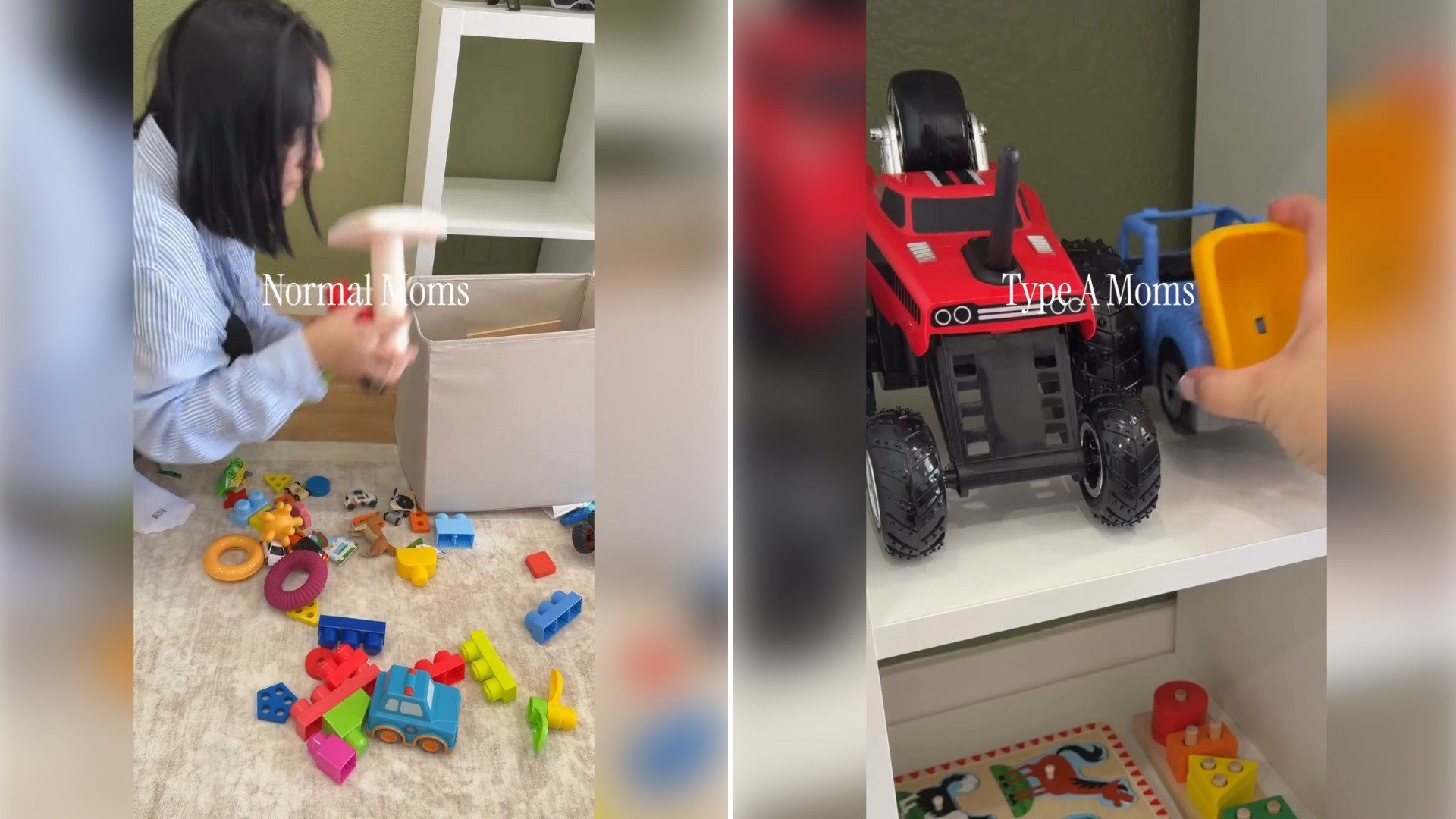
A creator who posts on Instagram as by.alenaugc acted out two ways of picking up a floor full of toys in a 13-second reel, labeling the first “Normal Moms” and the second “Type A Moms.” Her caption leaves little doubt about which one she is: “Please tell me I’m not the only one.”
The first half is fast. Wearing a blue striped button-down, she kneels on a cream rug in front of a white cube shelf, surrounded by plastic building blocks, wooden rings, a toy hammer, a chunky blue car and a few small die-cast ones. She scoops them up with both hands, a handful at a time, and drops them into a fabric bin. About four seconds in, the rug is bare and the bin is heaped.
Then the label changes to “Type A Moms” and the same toys get a very different send-off. She presses the last pieces into a wooden animal puzzle until the board is complete. She threads shapes onto a wooden sorting board so that each post holds a single color, running red, orange, yellow, green and blue down the row. The finished puzzle and the sorter go flat into one of the shelf cubes.
The last few seconds belong to the trucks. A red monster truck is already parked on top of the shelf. She sets a blue dump truck with a yellow bed beside it, picks it back up, turns it around so that its cab faces out the same way as the monster truck, and puts it down again. Then she reaches over and adjusts the red one too.
Nothing is explained in the reel. The only words on screen are the two labels, and the caption adds a string of laughing and shrugging emojis and a credit to another account for the idea, along with tags including #relatable and #toyorganization.
The joke works because both halves end in the same place, a clear floor, and get there at completely different speeds. That is also what makes it useful. The two methods are not rivals. They suit different toys.
Tossing is the right call for anything that has no set to complete. Building blocks, rings, balls and little cars play just as well out of one big bin as they do from five small ones, and a single bin is something even a very young child can help fill. If the goal at the end of the day is a floor you can walk across, the four-second version does the job.
Sorting earns its time on toys that only work when every piece is there. A peg puzzle with one animal missing or a shape sorter short a block gets abandoned quickly. Finishing those before they go on the shelf, the way she does in the second half, doubles as a parts check. If a piece is missing you find out while it is still somewhere on the rug, not three weeks later.
Her shelf shows the other benefit. A completed puzzle lying flat in a cube and two trucks parked on top are easy for a child to see and choose from. A deep bin hides what is at the bottom, which is why kids tend to dump the whole thing out to find one car.
A workable routine uses both. Keep one open bin for the loose stuff and make the nightly pickup a toss. Give puzzles, sorters and anything with matched parts a flat spot on a shelf, and put those away complete. Once a week, or whenever the bin gets hard to dig through, tip it out and pull back the pieces that belong to a set.
The sorted version can also be handed to the kids as play. Matching colors on the sorter and fitting the animals back into the puzzle are the activities those toys were made for, so doing them at cleanup time is one more turn with the toy. Lining up trucks to face the same way is optional.
That last detail is where she is laughing at herself. Turning the dump truck around does nothing for the toy or the child. It is for the adult who will walk past that shelf later. Her caption, asking to be told she is not the only one, treats it as a quirk and not a standard, which is the healthy way to hold it. If a straight row of trucks makes you feel better about the room, take the five seconds. If it does not, the bin is waiting.