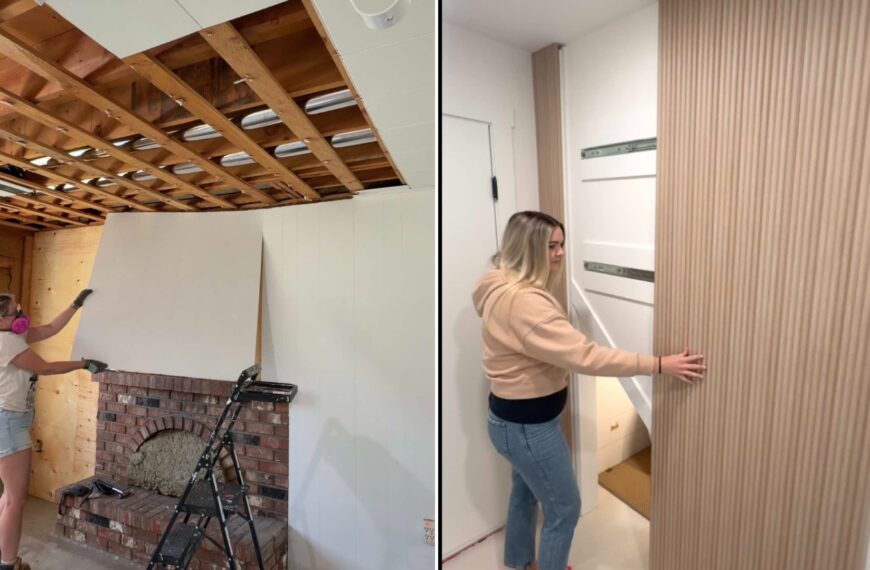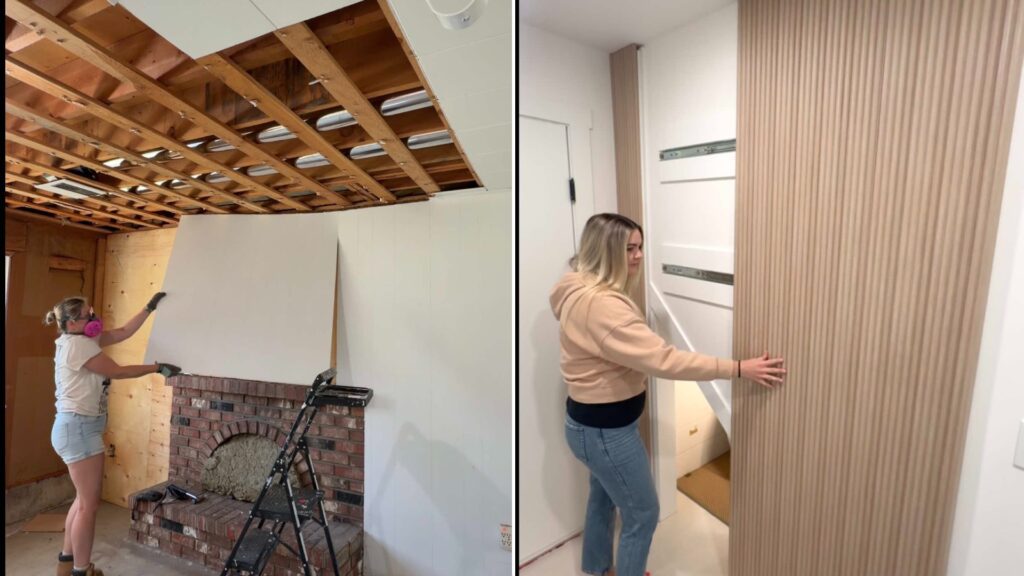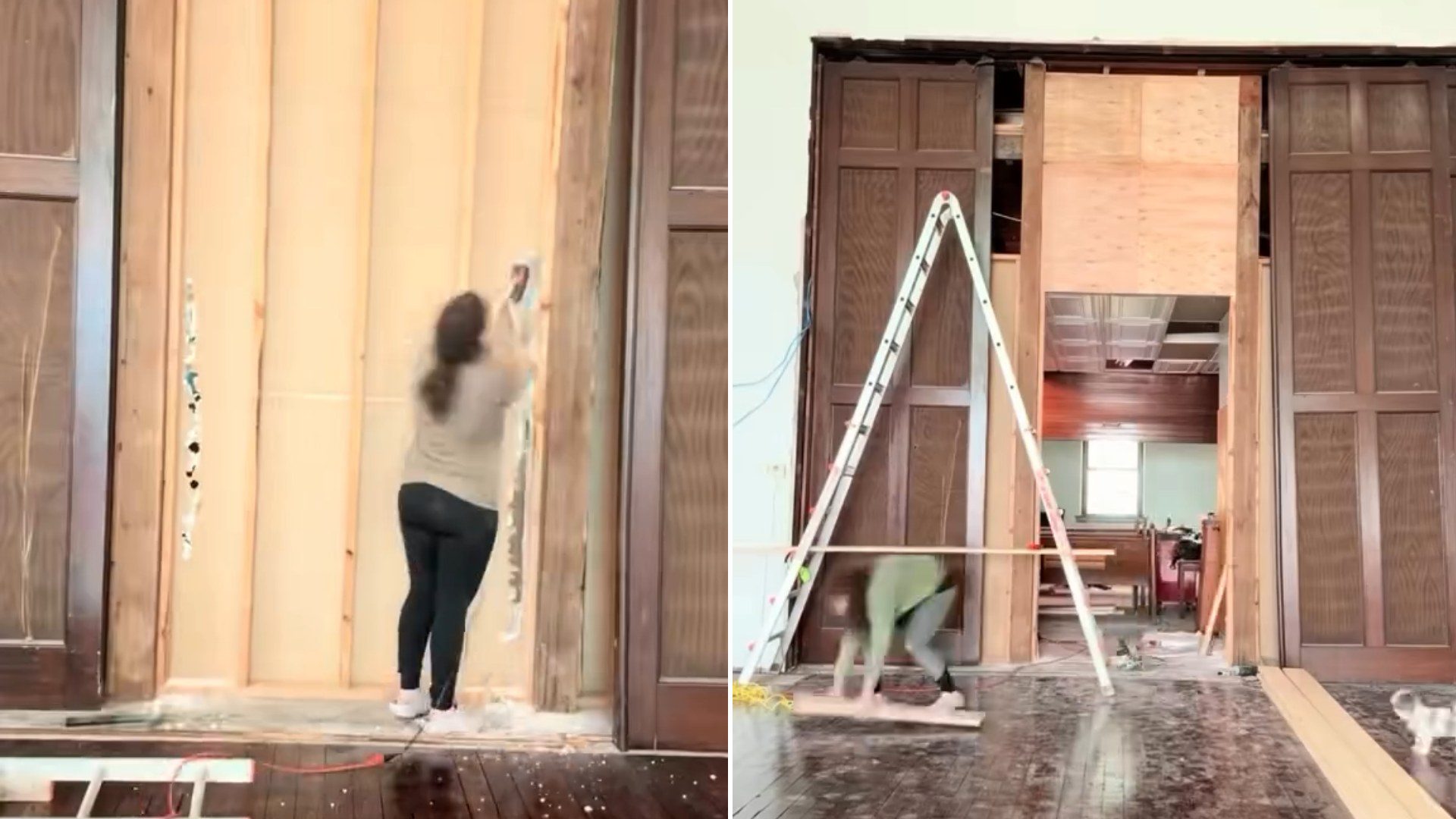
A pair of 15-foot pocket doors, sealed inside a wall since 1926, turned out to be exactly what longtime locals had been telling the new owners of a century-old building to go check for. The restoration is documented in an Instagram reel, and it’s earned 121,900 views on an account that typically pulls a fraction of that, a 60-times jump that suggests people are genuinely hungry for real before-and-after architectural salvage rather than another quick flip video.
A Detail Almost Nobody Would Have Found on Their Own
Pocket doors of that scale don’t announce themselves. Once a pocket door is closed and its opening gets plastered or drywalled over during a later remodel, there’s no visible seam, track, or hardware left to signal that anything is hiding in the wall cavity at all. The only reason this pair got found is that people who’d known the building for decades remembered it, which is a reminder that a lot of a century-old structure’s real history lives in the memory of longtime neighbors rather than in any inspection report.
Why Builders Went This Big in the First Place
Pocket doors have been part of American residential and commercial buildings since the 1850s, according to This Old House, with floor-mounted tracks giving way to overhead hardware by the 1880s. A separate history from The Craftsman Blog notes the format hit peak popularity from the 1850s through the early 1900s in Victorian, Italianate, and Colonial Revival buildings, prized because it let owners reconfigure a room’s flow without the floor space a swinging door eats up. A 15-foot pair, installed in 1926, would have been a genuine architectural flex for whoever commissioned this building, the kind of statement hardware meant to impress rather than just separate two rooms.
What Actually Made These Doors Last a Century
The doors that survive from this era tend to survive because they were overbuilt to begin with. The Craftsman Blog describes historic pocket doors as “solid, heavy doors that ran on cast-iron rollers along tracks crafted with precision,” typically built from dense hardwoods like mahogany, oak, or walnut, with hardware in cast iron, steel, or brass designed to last for decades or centuries. That’s a sharp contrast with what replaced the format later in the 20th century: hollow-core particleboard doors on plastic rollers that fail within years rather than generations. A century sealed inside a wall, untouched by daily use, may have actually protected these particular doors better than if they’d stayed in service the whole time.
The Real Work of Bringing Hardware Like This Back
Restoring a hidden pocket door isn’t a matter of just pulling it out and rehanging it. This Old House notes that hardware failure, loose screws, worn rollers, and derailment are the most common issues with old pocket door systems, and that even a straightforward reinstallation with new period-appropriate hardware runs about $500 in hardware alone and six to eight hours of labor, on top of removing existing trim, prepping the pocket opening, leveling the door, and lubricating the track for smooth operation. A pair that’s been sealed in plaster since 1926 adds another layer of unknowns: whether the original track survived intact, whether the wood needs stabilizing, and whether new hardware can be sourced or has to be custom-matched to century-old hangers.
What Other Old-Building Owners Should Look For
Anyone who owns a building from this era and has heard a similar rumor from a longtime neighbor has a few real signs to check before opening up drywall. An interior wall that’s noticeably thicker than the others nearby, roughly double, can indicate a hidden door pocket. A header trim detail that runs wider than a standard doorway, or floor transitions that don’t quite line up with where a current wall sits, are both clues worth investigating before assuming a wall is solid. The Craftsman Blog’s restoration guidance also warns against defaulting to big-box hardware when reinstalling anything found this way, recommending purpose-built restoration hardware brands like Johnson Hardware instead, since generic modern rollers and tracks are built for lighter, hollow-core doors rather than the solid hardwood slabs this era used.
The more than 121,000 people who’ve watched clearly aren’t there for the drywall dust. They’re watching because a building holding a piece of its original architecture for a hundred years, waiting on the right owner and the right tip from a neighbor, is a rarer story than most renovation content manages to tell, and this one didn’t need any embellishment to earn its views.