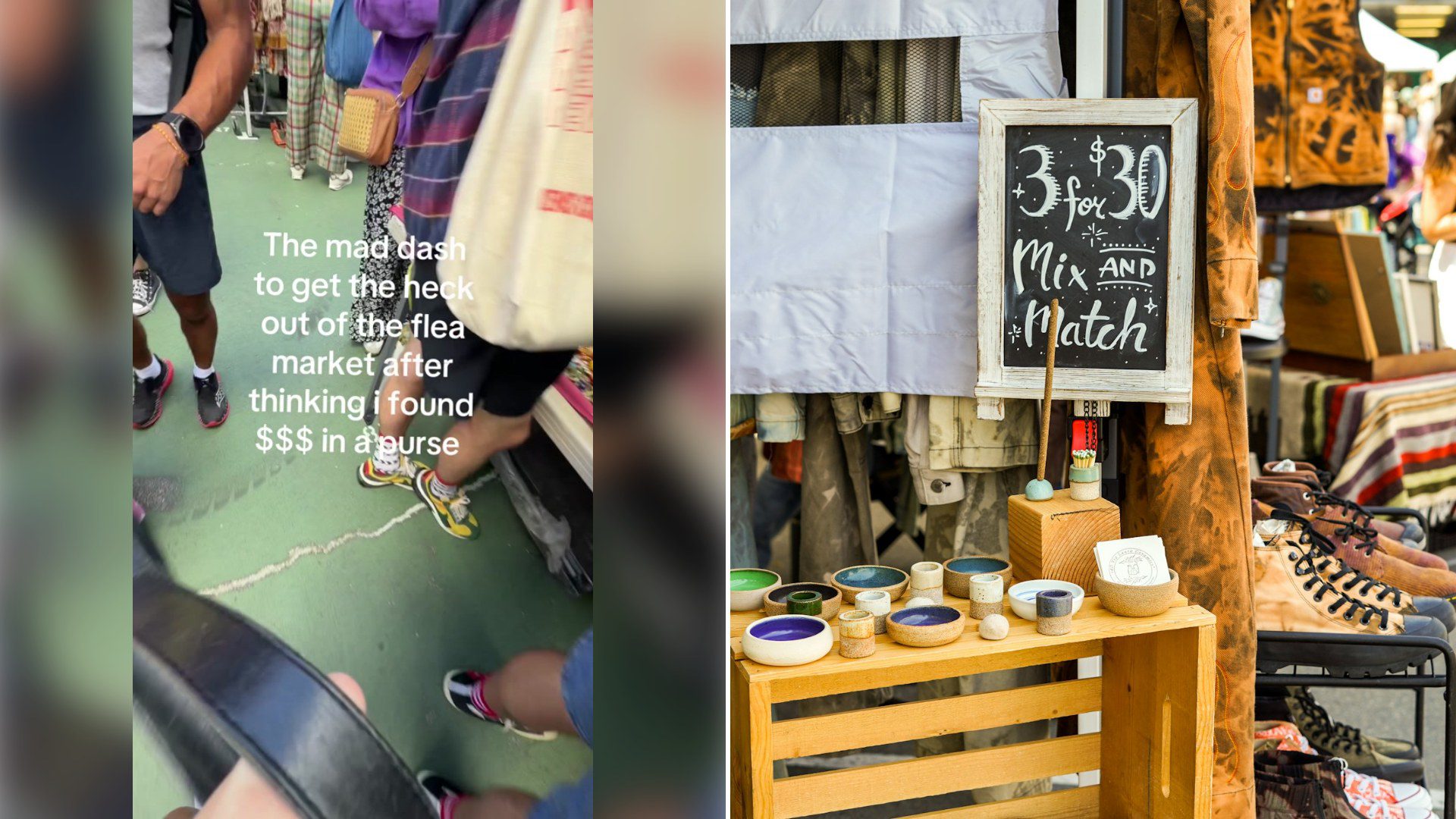
A black leather purse at a New York City flea market turned out to be holding more than its last owner meant to give away. In a 15 second clip, thrifter @bus.queen films herself hurrying out of the market with the bag in her hand, convinced there is money hidden inside it. The text on screen sets the scene in her own words: “The mad dash to get the heck out of the flea market after thinking i found $$$ in a purse.”
The video opens with the purse held out in front of her above the green painted pavement of the market, with vendor tables draped in yellow cloths just behind it. It is a structured black bag with a front flap, a metal turn lock clasp and a long, thin shoulder strap. Then the camera swings down toward her white sneakers and the legs of other shoppers as she weaves through the crowd toward the way out.
Once she is clear of the stalls, she rests the bag on a ledge and lifts the flap. Her fingers work into a slim pocket along the inside of the purse, and a flash of bright red appears at the opening. She slides it partway out. It is a small red envelope that had been sitting flat inside the pocket.
The clip then cuts indoors. She is sitting down, wearing a cream T-shirt printed with the words “Pardon My French,” and the red envelope is in her hands. New text appears on screen: “I was right.” She opens the flap of the envelope, reaches in and pulls out a folded bill. When she turns it toward the camera, the number 100 is visible in the corner. She glances up at the lens with the bill in her hand, and the clip ends there.
Her caption is brief. “NYC treated me well,” she writes, and then adds a line that turns a lucky find into an open invitation: “If you are the original owner of this purse let me know!” The video does not say what she paid for the bag, which stall it came from, or whether anything else was inside. What it does show is the whole sequence in order: the suspicion, the exit, the check and the proof.
For anyone who clears out closets, the clip is a useful reminder from the other side of the table. Somebody let this purse go with an envelope of cash still in it. Bags are some of the easiest things to donate or sell in a hurry, and they are also some of the easiest places to lose track of money, because they are full of compartments that nobody looks in once the bag goes into storage.
Before a handbag, tote, backpack or diaper bag leaves the house, give it a full search instead of a quick look. Unzip every pocket, including the flat slip pockets against the lining, where an envelope or a card can sit unnoticed the way this one did. Run a hand along the bottom and the sides to feel for anything that has slipped through a torn lining. Turn the bag upside down over a table and shake it. Then check any matching wallet, coin pouch or cosmetic case that is going out with it.
The same goes for the other hiding spots that turn up during a declutter: coat and jeans pockets, old wallets, greeting cards saved in a drawer, books, and gift envelopes that were set aside to deal with later. Gift money in particular tends to get put somewhere safe and then forgotten. A good habit is to open every card and envelope before it goes into the recycling, and to empty every bag on the day it is retired, not months later when it is finally dropped into a donation box.
Families sorting through a relative’s belongings should be especially careful. When a dozen bags and coats are being boxed up at once, it is tempting to send them out the door unopened. Give one person the job of checking pockets and compartments before anything is priced for a yard sale, taken to a donation center or handed to a reseller. It takes about a minute per item, and it is the last chance to catch what is inside.
Shoppers can take something from the clip too. A thorough look inside a secondhand bag before buying is worth doing for practical reasons. It shows the condition of the lining, whether the zippers work, and whether anything has been left behind. Old receipts, pens and tissues are the usual finds. If something with a name on it turns up, such as an ID, a bank card or a prescription label, hand it to the vendor or the market organizer so it has a chance of getting back to the person it belongs to.
Cash has no name on it, which is why the caption from @bus.queen matters. She showed the bag on camera and asked the person who used to own it to speak up. For everyone else, the lesson costs nothing. Check the pockets before the purse leaves the house.