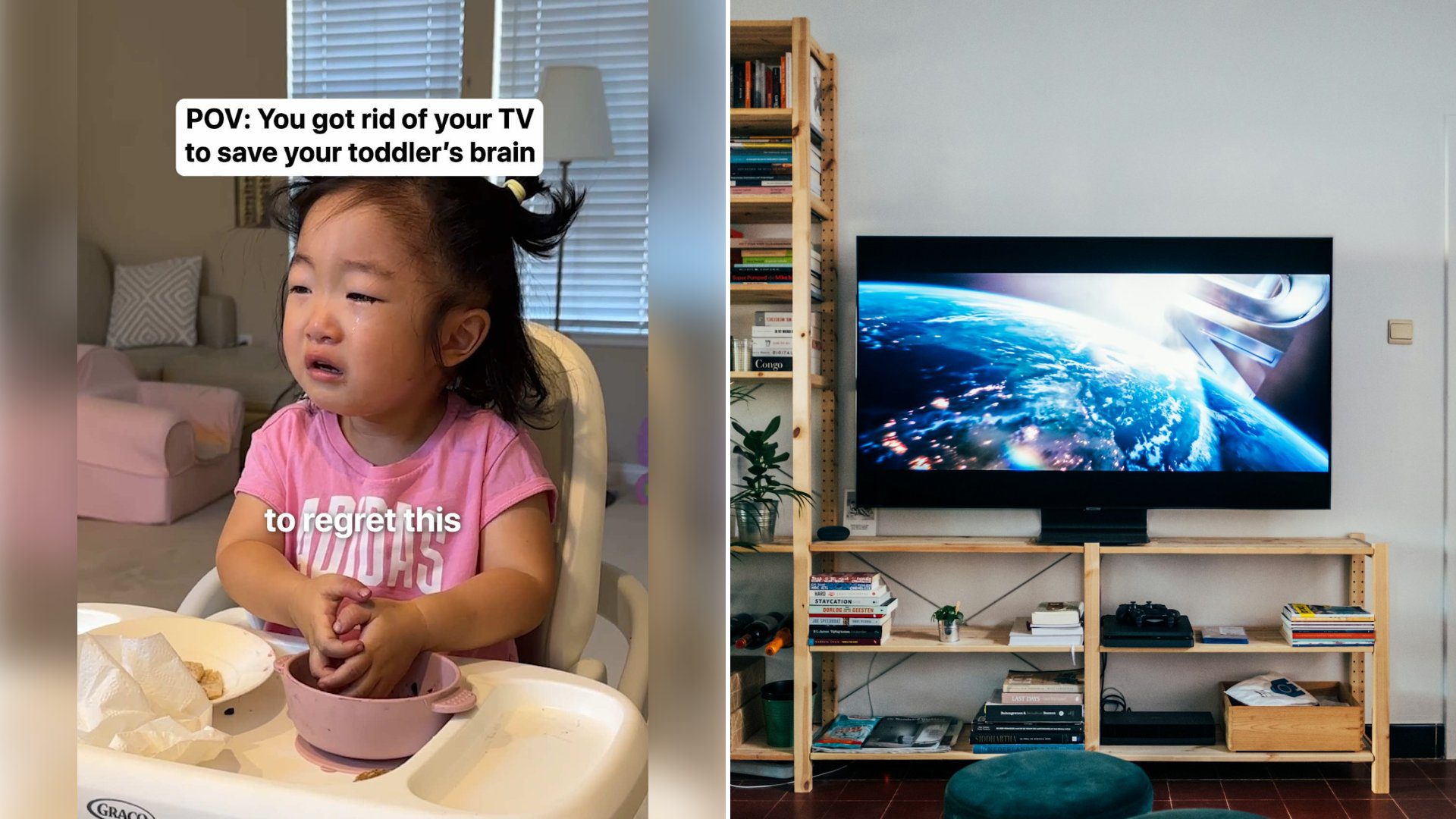
A video from the account Koohry | Semi-Crunchy Dad opens with text reading “POV: You got rid of your TV to save your toddler’s brain,” over footage of a crying toddler in a high chair. His caption gets specific about the decision and the results: “We got rid of the tv… yes permanently. How will my toddler react? Keep in mind, no TV doesn’t mean no screen time. She still watches sometimes on her phone or our laptop! The point is, with the TV gone her screen time went down by 50%!” He explains the logic behind why removing just the TV made such a difference: she knew how to turn it on herself, and it sat in the living room where she saw it first thing every morning, making it a constant, hard-to-resist temptation in a way a phone or laptop, kept with a parent, simply wasn’t. The clip pulled in 116,700 likes, 331 comments, 13,000 saves, and 16,100 shares.
@koohry We got rid of the tv… yes permanently #parenting #toddler #screentime #brainrot #baby
The specific mechanism this dad describes, a TV that’s always there, always accessible, and always one button-press away, lines up with what pediatric researchers have found about background television specifically, not just screen time overall. The American Academy of Pediatrics’ guidance explicitly recommends eliminating background TV, television left on in the room even when no one is actively watching it, because research shows it pulls a young child’s attention away from play repeatedly throughout the day. A loud sound effect or a flash of color on screen is enough to interrupt a toddler mid-task, even during activities like block-stacking that would otherwise build focus and problem-solving skills.
Background TV doesn’t just compete with a child’s attention, it also competes with a parent’s. Research on this dynamic has found that when a television is on in a room, parents become measurably less responsive to their child’s bids for attention and engage in fewer of the back-and-forth verbal exchanges that are central to early language development, since some of their attention is inevitably pulled toward the screen even during quiet moments. That’s a meaningfully different effect than screen time in the direct sense, it’s not about what a child is watching, it’s about what a parent misses while a screen holds any part of their attention.
The AAP’s broader screen time guidance for toddlers backs the instinct behind this swap, too: media use is discouraged entirely before 18 months outside of video chatting, and for children two to five, the recommendation caps screen time at roughly one hour a day of high-quality content, watched with a caregiver when possible rather than alone. A phone or laptop, handed over deliberately and put away afterward, fits that model of bounded, intentional use far more naturally than a television that’s simply always on and always in view.
The 50 percent reduction this dad reports tracks with a simple behavioral reality: removing the easiest, most passive option doesn’t eliminate screen time, but it does force every remaining instance of it to be a deliberate choice rather than a default. For a toddler who could turn the TV on herself, that’s the difference between screen time being an ambient condition of the living room and screen time being something a parent actively decides to offer.
More from Decluttering Mom
- Mom of Two Opens Her Three Car Garage on a Doom Pile of Boxes, Finds Diapers From a Subscription Still Running and a Sauna Boxed for a Year, Then Clears Enough to Park Inside
- Homeowner Whose Husband Said He Could Not See the Garage Floor Hauls Out Four Years of Stuff, Patches and Paints One Wall White, Then Hangs Bikes, Helmets and a Vacuum on Rails
- Woman Says She Came Home From a Cleaning Service Visit to a Gas Burner Left On With No Flame, Then Found Her Purse, Tax Documents and Real Silverware in Two Garbage Bags Downstairs