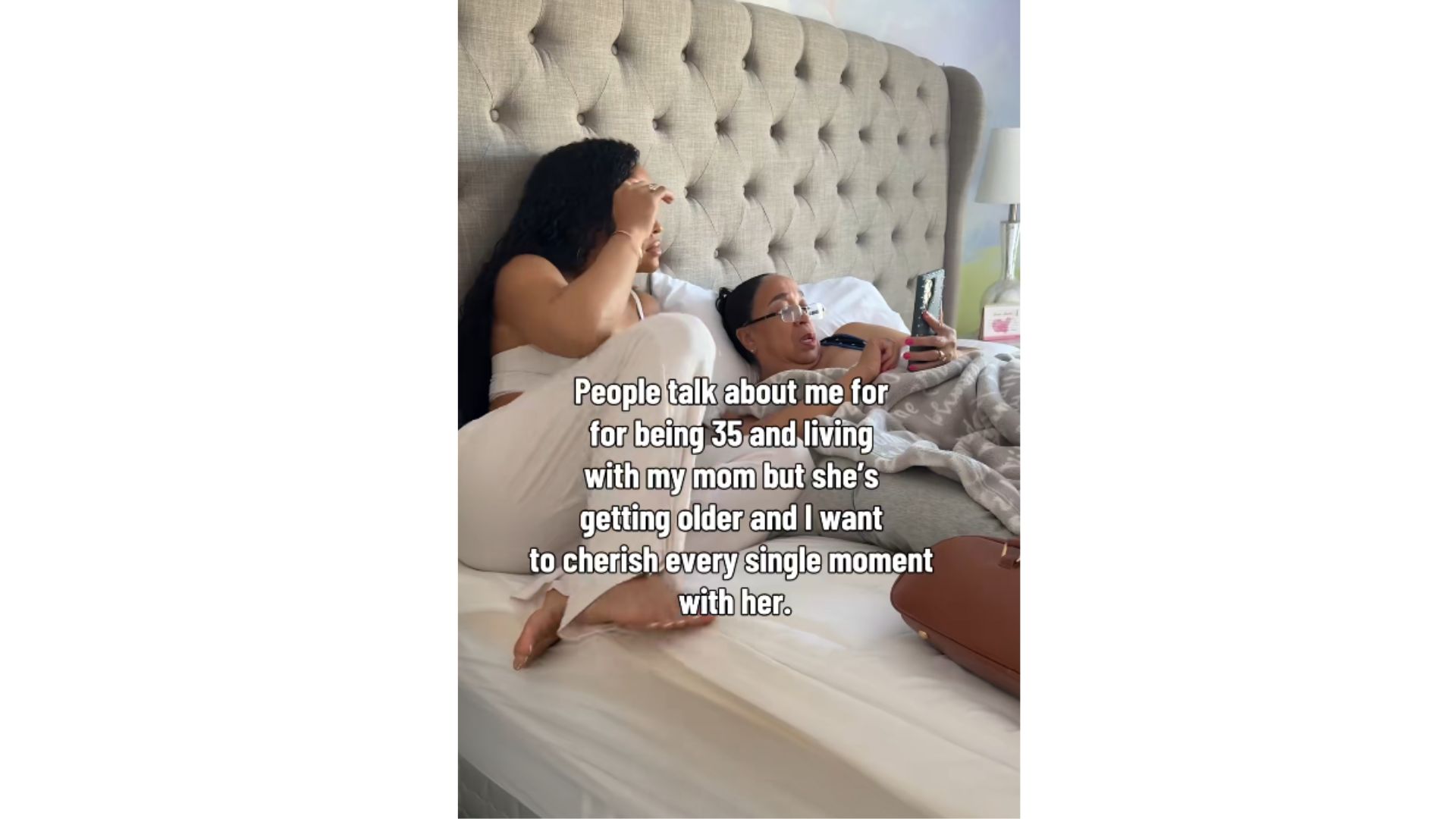
When Amber Moriah Jones moved back into her mother’s house at 35 years old, she wasn’t running from a financial crisis. In a TikTok video that has since sparked a wide conversation about adult children and aging parents, @itsambermoriah explained that she can afford to live on her own. She simply chooses not to, and she is done apologizing for it.
Jones said the decision traces back to the sudden death of her father. Losing him upended the family’s sense of stability overnight, and in the aftermath, Jones said she watched her mother facing an empty house and an uncertain future alone. Rather than let her mother navigate grief, bills, and an entire home by herself, Jones said she made the call to move back in. It wasn’t about rent she couldn’t afford elsewhere. It was about a parent she didn’t want to leave alone.
That explanation hasn’t stopped the judgment. According to Jones, friends and acquaintances have questioned her choice from nearly every angle: her independence, her love life, her ambition, even her mental health. She said people who have never met her mother, never experienced the kind of loss her family went through, and never seen what daily life in that house actually looks like feel entitled to an opinion anyway. In her video, Jones pushed back directly, arguing that a 35-year-old woman living with her mother by choice is not a red flag. It is, in her framing, a reflection of priorities other people simply don’t share.
Jones has also been candid that the arrangement wasn’t smooth from day one. She has described the first two years after moving back as genuinely rocky. Two adult women who had each grown used to running their own households suddenly had to relearn how to share space, schedules, and decisions. Jones said there were arguments over small things that were really about bigger adjustments: whose routines took priority, how chores got divided, and how to give each other privacy inside one home. Neither of them had lived like this in a long time, and pretending it was easy from the start would have been dishonest.
What eventually smoothed things out, Jones said, was structure. The two women worked out who covers which expenses and which chores fall to whom, rather than assuming things would sort themselves out organically. Jones has framed the current version of the arrangement as a genuine partnership rather than a daughter moving back into her childhood bedroom. She contributes financially, she contributes labor around the house, and in return she gets to spend her thirties with the one parent she has left, instead of visiting on holidays and feeling like a guest in her mother’s life.
The response online has split fairly cleanly. A large portion of commenters pushed back on the idea that living with a parent as an adult is inherently a setback, pointing out that in many cultures around the world, multigenerational households are the norm rather than the exception. Others admitted they’d made assumptions about people who still live with their parents and were rethinking that instinct after hearing Jones’s reasoning. Still, a vocal group continued to press her on independence and what a partner might think of the setup, questions Jones has addressed by noting that her home life is not a temporary stopgap; it’s a decision she stands behind.
When Multigenerational Living Actually Works
Jones’s story lands at a moment when more American adults are living with parents or adult children than at almost any point in recent decades, often for reasons that have nothing to do with failure to launch. Whether the motivation is grief, caregiving, cost of living, or simply wanting to be close to family, these households can work well when a few ground rules are set early rather than left to chance.
- Put expenses in writing. Decide up front who covers groceries, utilities, and the mortgage or property taxes, even if the split isn’t perfectly even. Vague verbal agreements tend to become resentments later.
- Divide chores by strength, not habit. Instead of defaulting to old roles from childhood, assign tasks based on who’s actually best positioned to handle them now, and revisit the split every few months.
- Protect private space and private time. Even in a shared home, each person needs a room, a schedule, or a routine that’s theirs alone. Jones has pointed to this as one of the biggest adjustments in her own home.
- Talk about the plan, not just the present. Is this arrangement open-ended, tied to a specific need, or a long-term choice? Naming the intention out loud prevents a lot of quiet frustration down the road.
- Expect a rough patch, and don’t panic when it comes. Jones has been upfront that her first two years back home were difficult. Friction while two adults relearn how to co-exist doesn’t mean the arrangement is failing.
For Jones, the calculus has never really been about whether she could afford an apartment of her own. It’s about what she wants her thirties to look like, and who she wants beside her while she lives them. “I can afford to move out,” she has effectively told her critics. “I’m choosing not to.” For a growing number of adults navigating grief, caregiving, and family closeness on their own terms, that distinction may matter more than anyone realizes until they’re the ones living it.