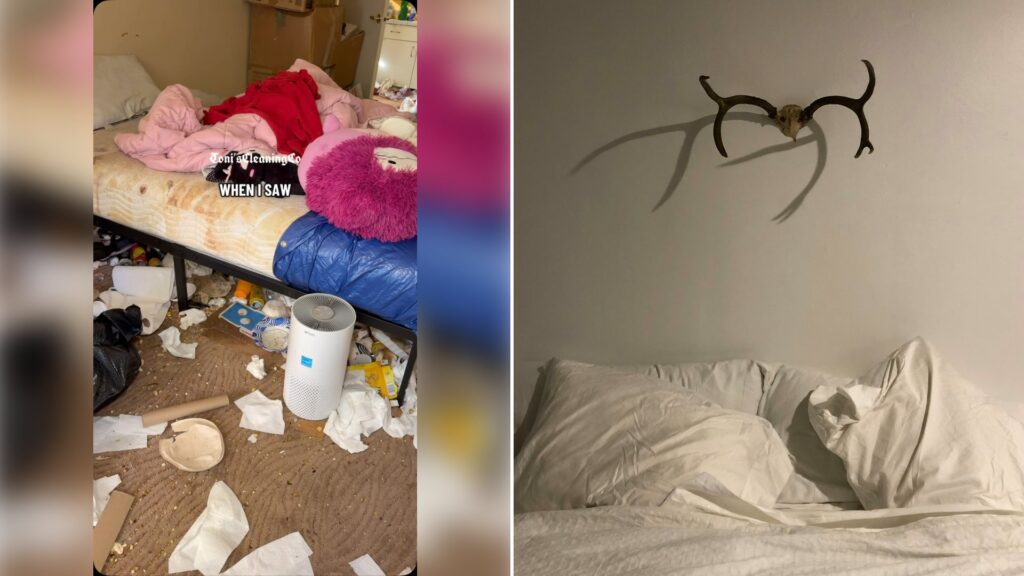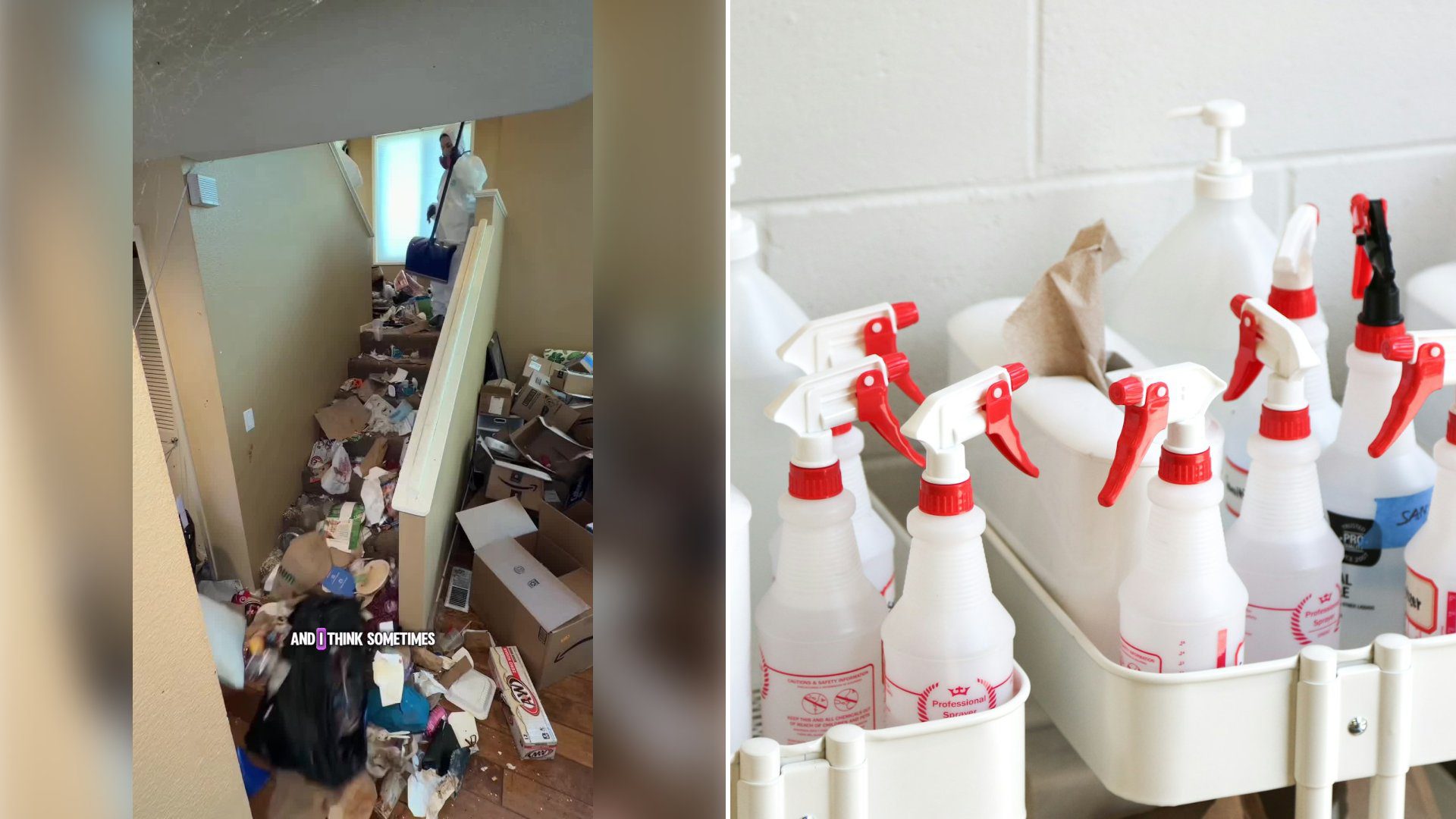
On screen, people in white protective coveralls and masks work their way through a home where trash and boxes cover the stairs, the hallway and nearly every inch of a room’s floor, filling grey bins and black bags as they go. Over the footage, Tanika of rvlivingwitht talks for 140 seconds, and her subject is the person watching rather than the people who live there.
“I think sometimes we forget what a privilege it is to look at somebody else’s situation and genuinely not understand how they got there,” she begins. “If you’ve never experienced depression so heavy that brushing your teeth feels like an accomplishment, that is a privilege.” She runs the same line through grief that changed someone’s ability to function, and trauma that put a brain into survival mode.
She says the free cleans she does are what taught her this. “You cannot look at the condition of someone’s home and assume, you know, the condition of their heart, their life, or what they’ve survived,” she says. When they walk into these homes, she says, they hear what happened and what people lost. “Sometimes the mess is just the part of the story you can physically see.”
She is blunt about what the job is not. “We’re not there to stand in their home and ask, how could you live like this? We’re there because they finally let somebody in.” Letting strangers into the place you have been hiding, she says, “takes vulnerability, and that takes trust.” And she has a message for strangers tempted to pile on: “They know their house is bad. They know. Trust me, they do.”
What they need instead, in her words, is “a starting point.” She lists what that can look like: a clean bedroom, being able to shower in their own bathroom again, being able to sit on their couch, or waking up to an environment that no longer feels impossible.
She does not oversell it. “Cleaning does not cure depression. It doesn’t erase trauma,” she says, and it does not bring back someone they lost. “But sometimes, removing one overwhelming thing from somebody’s plate gives them enough room to breathe.” Her closing ask is a swap of questions: instead of “how could someone live like this?” she wants viewers to ask “what might have happened to this person?” The caption says the full free clean is posted on her YouTube channel. She signs off: “Welcome to my Tanika talk.”
What Depression and Hoarding Actually Look Like
The National Institute of Mental Health lists the signs and symptoms of depression, and several of them bear directly on keeping up a home: “fatigue, lack of energy, or feeling slowed down,” “difficulty concentrating, remembering, or making decisions,” and “loss of interest or pleasure in hobbies and activities.” For a diagnosis, NIMH says, symptoms must be present most of the day, nearly every day, for at least two weeks.
A cluttered house is not the same thing as a hoarding diagnosis, and the video does not say what led to the condition of this one. The American Psychiatric Association defines hoarding disorder as “persistent difficulty getting rid of or parting with possessions,” where trying to discard things causes real distress and the clutter makes living spaces hard to use. It puts overall prevalence at about 2.6 percent, says rates are higher in adults over 60 and in people with anxiety or depression, and lists treatment options including self help books, support groups, individual talk therapy, medications and group therapy.
If Someone You Love Is Living Like This
Her advice to start with one usable space lines up with something concrete you can offer a relative or friend whose home has gotten away from them:
- Skip the question she warns against. Ask what would help first, and offer one space from her list: the bedroom, the bathroom so they can shower, or the couch.
- If the low energy, trouble deciding or loss of interest on NIMH’s list has gone on for weeks, encourage a visit to a doctor and offer to go along.
- If letting go of things is the sticking point, the APA lists therapy, support groups and medication as options, so a referral is a reasonable next step.
- For a referral to local treatment, the SAMHSA National Helpline at 1 800 662 4357 is free, confidential and open 24 hours a day, every day of the year, in English and Spanish. In a crisis, call or text 988.
- For an older parent, the federal Eldercare Locator at 800 677 1116 connects families to local help such as meals, home care and transportation, Monday through Friday, 8 a.m. to 9 p.m. Eastern.