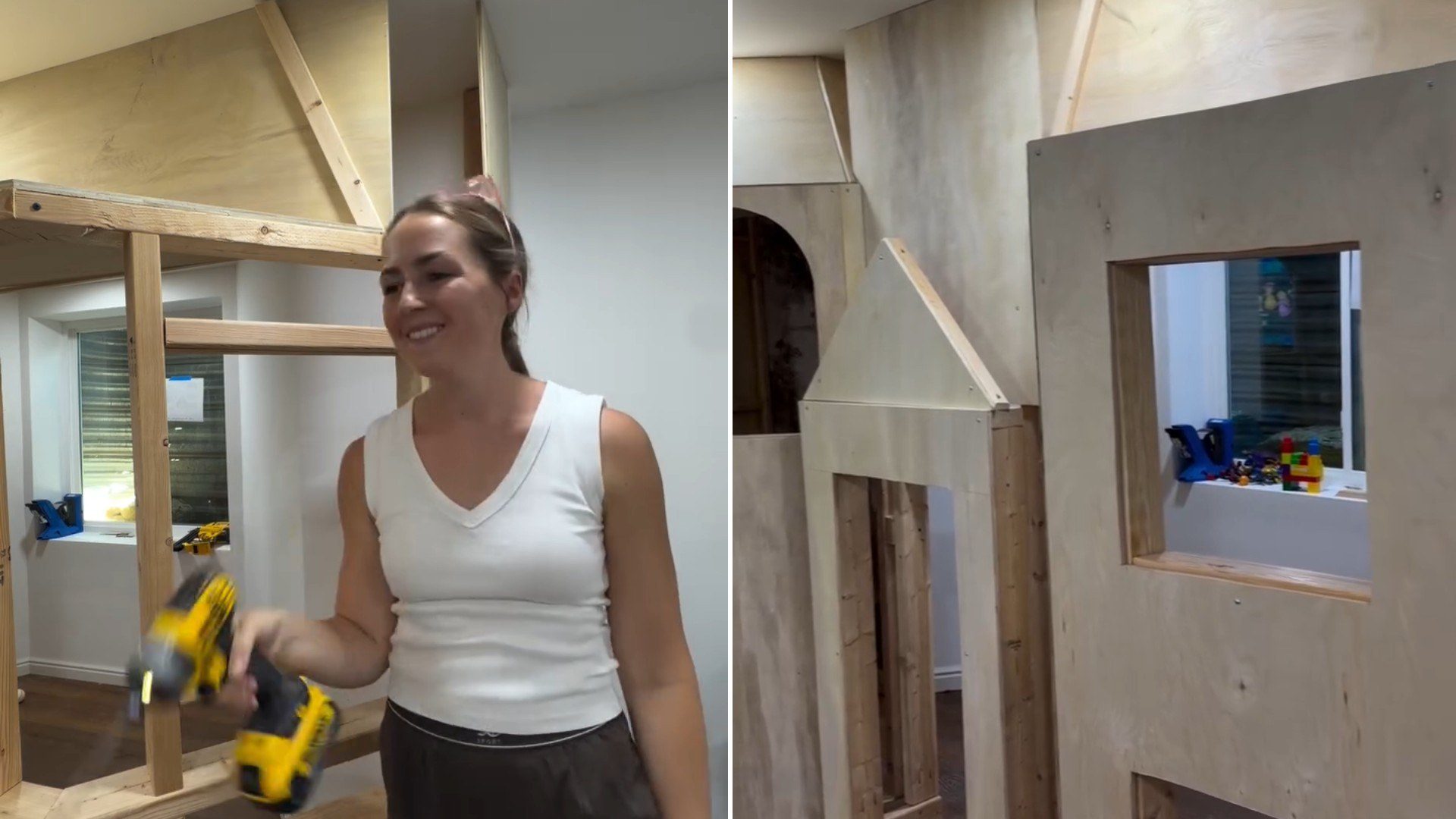
Every parent has fielded the request at some point: “Can we build a playhouse?” Most of the time, that idea quietly fades into the pile of things that never quite happen, replaced by a store-bought play tent or a corner of the yard designated as “the fort” in name only. But one mother decided to take her daughter’s dream seriously, transforming an empty corner of their basement into a fully custom playhouse, documenting the entire build day by day for anyone following along.
The project unfolds gradually across the series, giving viewers a genuine sense of the labor and planning involved rather than jumping straight to a finished reveal. Walls go up. Details get added. What started as an unused, forgettable basement corner slowly transforms into something that clearly means a great deal to the daughter it’s being built for — a small, dedicated space entirely her own, built by hand rather than assembled from a box.
Her caption tracked the progress with genuine excitement: “Day 10 of building my daughter a house! 🏡 we finished the walls! Do you see where I’m going with thi…” That serialized, day-by-day framing turned the project into something closer to a mini home-renovation series than a single one-off video, and it clearly resonated. The post reached roughly 1.2 million views from an account with about 87,000 followers, a strong multiplier suggesting the project pulled in viewers well beyond her typical audience of followers already invested in her content. As @vivianshayhome shared in her post, there’s something genuinely compelling about watching an ambitious project unfold in real time, piece by piece, rather than only seeing the polished final result.
There’s also something worth noting about the timing of a project like this relative to a child’s age and stage of imaginative play. A playhouse built specifically for a daughter during the years when pretend play is at its most active tends to get significantly more use and emotional attachment than one introduced later, once a child’s interests have shifted toward other activities. Parents considering a similar project often find that catching that particular developmental window, rather than waiting for a more convenient time, makes a real difference in how much the finished space actually gets used and cherished.
Basement playhouse builds like this one tap into a broader trend of parents reclaiming underused spaces in their homes for dedicated kids’ areas, rather than treating basements purely as storage or utility space. As families increasingly look for ways to maximize existing square footage instead of expanding outward, converting an overlooked basement corner into something as imaginative and functional as a custom playhouse offers a compelling blueprint — proof that even modest, unfinished spaces can become genuinely magical with the right vision and effort.
There’s also a meaningful emotional layer to a parent choosing to build something like this by hand, rather than simply purchasing a pre-made play structure. A custom-built playhouse carries a different kind of value than something ordered online and assembled from instructions — it reflects direct, sustained effort specifically for one child, tailored to whatever design ideas she may have had a hand in shaping. That kind of personalized investment tends to leave a lasting impression, not just in the finished structure itself but in the memory of watching a parent dedicate real time and care to bringing an idea to life just for her.
For parents inspired to take on a similar project, even on a smaller scale, there are a few practical lessons worth taking from a build like this. Starting with a clearly defined, contained space — a basement corner, a closet nook, or even a section of a garage — makes an otherwise overwhelming project feel far more achievable than trying to design an entire freestanding structure from scratch. Documenting progress along the way, even just with quick phone photos rather than polished video, can help maintain motivation through a multi-day or multi-week project, since visible progress tends to make it easier to push through the less exciting middle stages of any build. And involving the child in small decisions throughout the process — color choices, layout ideas, small personal touches — tends to make the final space feel genuinely theirs, rather than simply a surprise handed to them at the end.
It’s also worth noting how the day-by-day format itself contributed to the project’s staying power with viewers. Rather than posting one finished reveal, the serialized approach turned the build into an ongoing story people could follow, check back on, and genuinely anticipate the next update for. That structure tends to build a much deeper connection with an audience than a single polished video ever could, since it invites viewers to feel like they’re part of the process rather than simply admiring a finished result from a distance.
What makes this particular project so satisfying to watch isn’t just the transformation of an unused basement corner into something imaginative — it’s the visible dedication behind it, unfolding one day and one wall at a time. In a world of quick, disposable purchases, a parent choosing to build something lasting and personal for her child, and sharing that patient process openly, clearly struck a chord with well over a million people who stopped scrolling long enough to watch it come together.