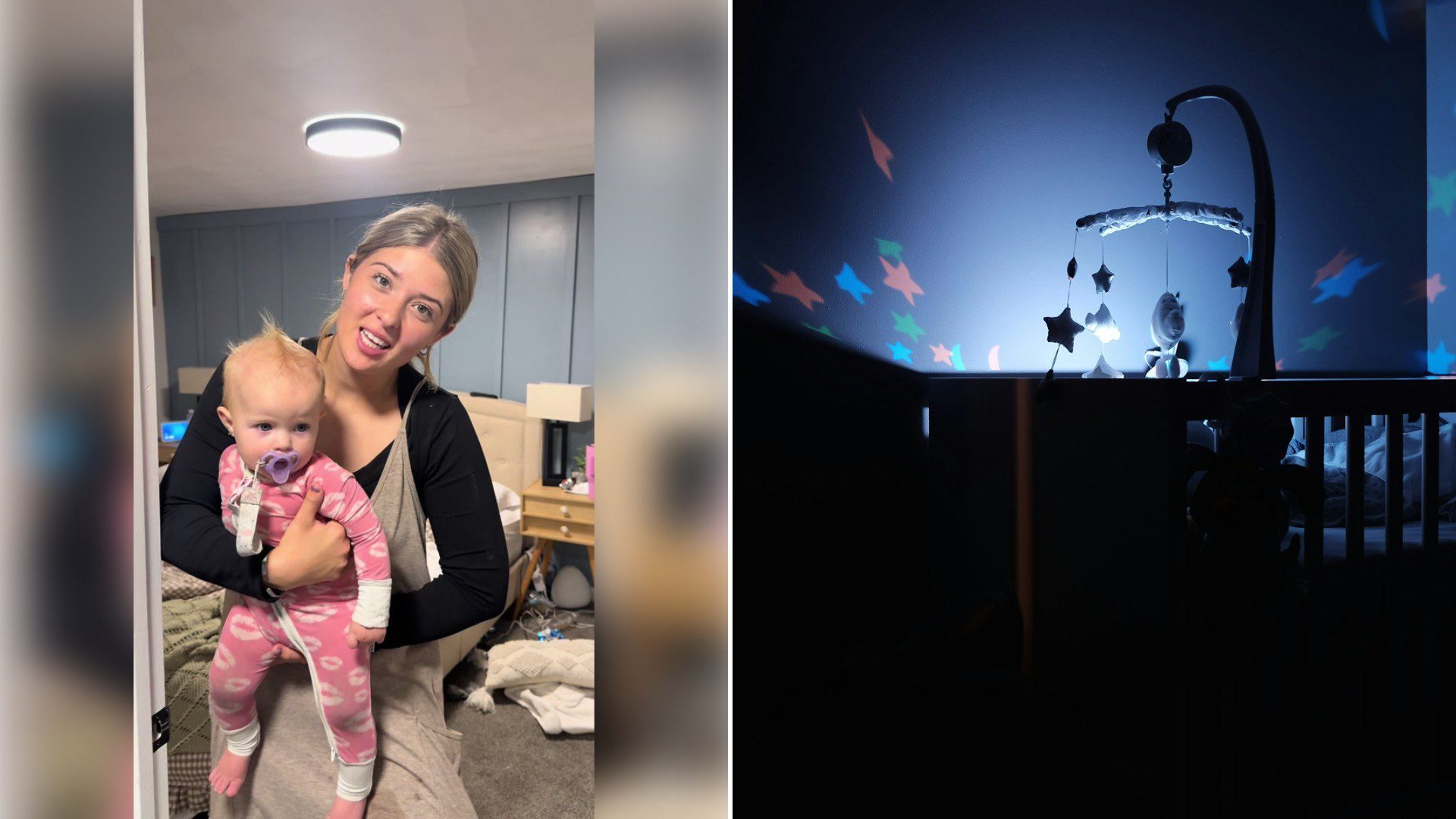
Sleep training is hard enough with one child, and a mother posting under the handle rayne.kennnn recently gave viewers an unfiltered look at just how much harder it becomes when three kids need individual attention on the exact same night. Her video documents a realistic, chaotic version of her nighttime routine as she moves from one child to the next, sleep training each of them separately while somehow keeping the entire evening from completely falling apart.
The footage captures the exhausting back-and-forth of managing three distinct bedtime processes rather than a single streamlined routine — different needs, different timelines, different levels of resistance, all happening within the same few hours. Her caption captures the triumphant exhaustion of finally finding something that worked, declaring with genuine excitement that she cracked the code, tagged with #momof3, #bedtime, #vlog, and #sleeptraining.
@rayne.kennnn I CRACKED THE CODE!!!!! #momof3 #bedtime #vlog #sleeptraining
The video clearly struck a nerve with parents facing similar multi-child bedtime marathons, pulling in approximately 2.9 million views from an account with about 504,300 followers — a significant jump in reach that suggests even a well-established parenting creator can still tap into something unusually resonant with the right slice of real, unpolished routine.
Sleep training multiple children individually rather than as a group is a genuinely underdiscussed logistical challenge. Every child responds differently to the same sleep training method, on different timelines, which means a parent managing three kids at once often can’t simply apply one strategy uniformly across the household. Instead, it becomes a kind of nightly triage — assessing which child needs attention first, how long each process is likely to take, and how to keep the other two occupied or settled while one gets individual focus.
What makes this kind of content so valuable to other parents isn’t a magic formula, since sleep training success is notoriously individual and rarely translates directly from one family to the next. It’s the simple, honest documentation of what the process actually looks like night after night — the false starts, the exhaustion, the small wins — rather than a polished summary that skips over how genuinely difficult the in-between stretch can be before things finally click.
For parents in the middle of their own multi-child sleep training marathon, the most useful takeaway from a video like this one isn’t a specific technique so much as the permission to expect a longer, messier process than a single-child timeline would suggest. Building in flexibility — accepting that some nights will go smoothly and others will require starting the whole sequence over from scratch — tends to reduce the frustration that comes from expecting immediate, uniform results across children who are, by nature, entirely different people with entirely different needs.
Ultimately, what rayne.kennnn’s video offers isn’t a shortcut, but something arguably more valuable: honest solidarity for any parent currently deep in their own version of the nightly sleep training gauntlet, along with proof that even the most chaotic multi-kid bedtime routine can, eventually, crack.
Sleep specialists frequently emphasize that consistency matters more than any single specific method when it comes to sleep training success, which becomes exponentially harder to maintain with multiple children on different developmental timelines. A technique that works cleanly for one child might need significant adjustment for a sibling with a different temperament, and parents managing several kids at once often have to hold multiple slightly different systems in their head simultaneously.
That complexity is part of why unfiltered sleep training content resonates so strongly with a broad parenting audience, well beyond just families with three kids. Even parents with a single child going through the same struggle find reassurance in watching someone navigate a harder version of the same challenge and come out the other side, since it reframes their own difficulty as normal rather than as evidence they’re doing something wrong.
For parents in the thick of their own sleep training process, professionals generally recommend giving any new approach a minimum of one to two weeks of consistent effort before judging whether it’s working, since short-term regressions and inconsistent nights are a normal part of the process rather than a sign the method has failed.
It’s also worth noting that documenting a hard-won routine, the way rayne.kennnn did here, often becomes a valuable resource for the parent herself down the line, not just for viewers. Looking back on footage of a chaotic multi-child bedtime a year or two later, once the routine has finally settled into something more predictable, tends to offer a genuinely satisfying reminder of just how far a family has come from its most exhausting nights.
There’s also a reminder here that a hard-won routine, once it finally clicks, rarely stays fixed forever. Sleep needs and habits shift again as children grow, which means the system rayne.kennnn celebrates in this video will likely need further tweaking down the road — a normal, ongoing part of parenting rather than a sign that the current solution was somehow incomplete.
In the meantime, videos like this one continue to circulate specifically because the struggle they capture never really goes out of date, no matter how many sleep training trends come and go.