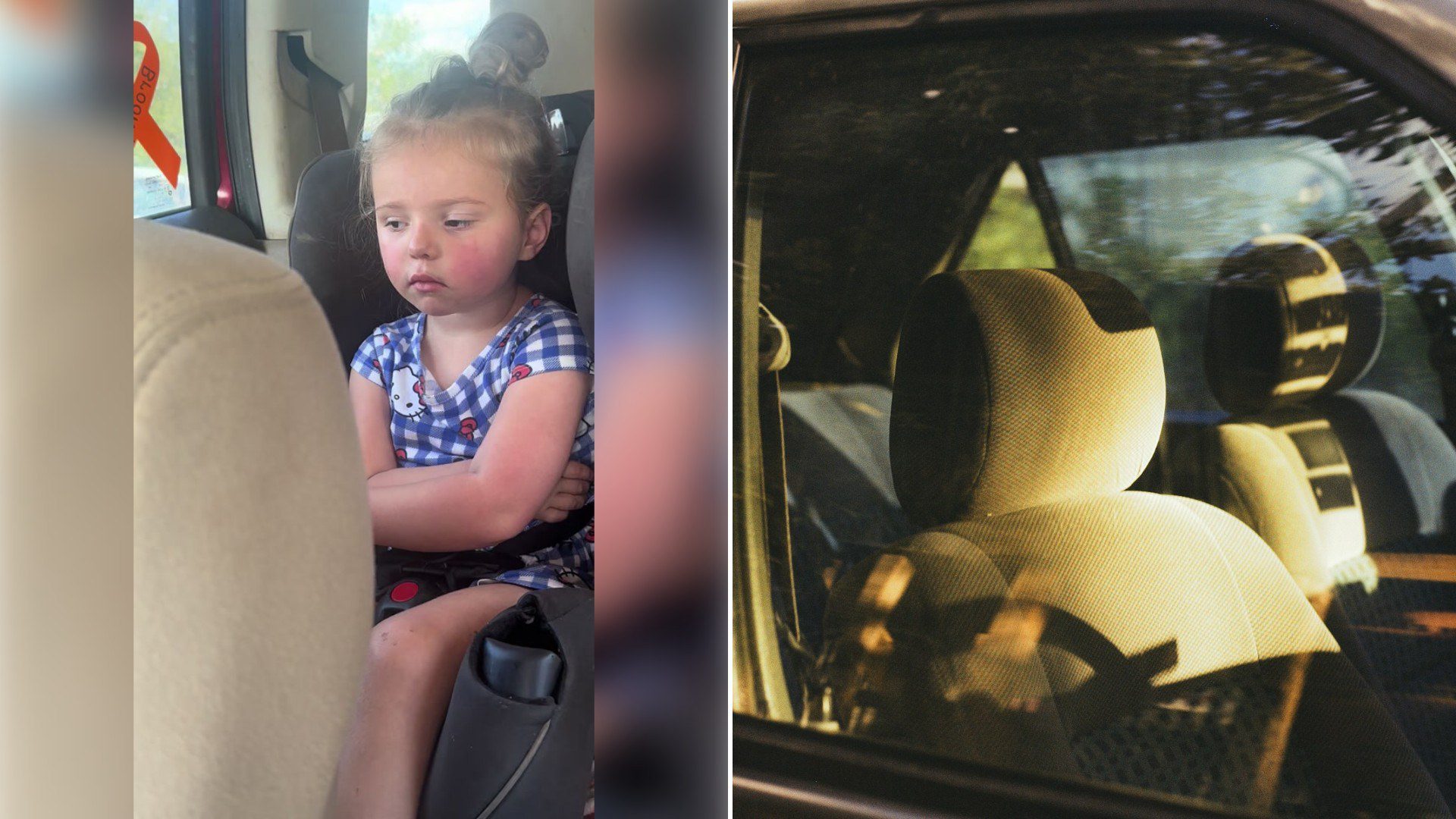
The video opens on a toddler in a blue gingham dress sitting in her car seat with her arms folded tight across her chest and her eyes cut hard to one side. The shoulder straps of the harness are not on her shoulders. From the front seat, the parent filming over a tan seat back gives the first instruction of what turns into a 48-second standoff: “Put your arms back in the straps right now and buckle that chest clip back up.”
The clip was posted by ayer1721_b.a.t_designs with the caption “The side eye queen” and the hashtags #sideeye, #toddler, #sassy, #iflookscouldkill and #mycarboncopy. The last tag claims the look as a family trait.
@ayer1721_b.a.t_designs The side eye queen 🫣🫣🤣#sideeye #toddler #sassy #iflookscouldkill #mycarboncopy
The toddler’s first answer is a long, slow blink. Then she drops her chin and gets to work on something in her lap, her hair in a small bun on top of her head and both hands busy at the buckle between her legs. The parent watches for a few seconds and corrects her: “That’s the bottom.” The instruction comes again, a little more specific this time: “Put your arms back in the straps and buckle the top back right now.”
She looks up at the front seat, then back down. Her hands go to the harness again, and whatever she does there earns a fresh observation from the parent: “Oh, you slid it down.” Then, for the third time, the same request with a new ending. “Well, put your arms back in the straps and slide it back to where it’s supposed to be right now.”
That is where the cooperation stops. For a few seconds she holds the parent’s gaze with one hand resting on the buckle, not moving. Then the arms fold back across her chest, her head turns away, and the look the caption promised arrives: chin angled toward the window, eyes sliding back toward the camera, lids half lowered.
The parent’s next move is one most children learn to recognize early. The parent says the toddler’s first and middle name, lets it hang there for a few seconds, and then adds: “if I get out this car to do it, you’re gonna be in trouble.” The toddler responds by turning her head all the way to the window, arms still crossed, and holding that pose until the video ends. The clip stops before anyone finds out who finished the buckling.
The auto-generated captions on the video pick up only the parent’s voice, and that is part of why the clip works. One side of the argument is made in calm, complete sentences. The other is made entirely with eyelids, a chin and a pair of folded arms.
It is also worth noticing what the parent is actually asking for, because all three requests are the right ones. A harness only does its job when the child’s arms are through both shoulder straps, the chest clip is fastened, and the clip sits up at armpit level across the breastbone. The three instructions in the video line up with three ways a toddler can loosen a harness without ever touching the main buckle: pulling her arms out, popping the chest clip open, and sliding the clip down toward her belly. A parent who knows that list knows what to look for in the rearview mirror.
The way the parent handles it is worth borrowing, too. The voice stays level. Each instruction names the exact part and the exact fix, from “that chest clip” to “slide it back to where it’s supposed to be,” instead of a general order to sit right. When the toddler fastens the wrong thing, the parent says so plainly, “That’s the bottom,” and repeats the request. A child who is able to undo a chest clip is usually able to redo it, and giving her the chance to fix it herself keeps the job in her hands.
The consequence is handled the same way. It comes only after three clear chances, it is a single sentence, and it is something the parent can carry out on the spot: getting out of the front seat and doing the buckling for her. A warning that can be followed through in the next ten seconds lands differently than a threat about later.
For parents dealing with their own escape artist, a few habits help. The car does not move until the harness is fully on, every time, so there is nothing to negotiate. If a child gets her arms out mid-drive, the fix is to pull over somewhere safe and redo the straps before going on, not to reach back while driving. Straps that are snug are much harder to wriggle out of, and a quick check is to try pinching the strap at the collarbone. If the webbing pinches into a fold, it needs tightening. Thick coats and bulky layers under the harness add slack, so they are better taken off before buckling.
It also helps to give a toddler a part of the job before the standoff starts. Letting her click the chest clip herself while the parent handles the bottom buckle, or asking her to check that the clip is “up high,” gives her the control she is reaching for when she pulls her arms out.
None of that guarantees a cheerful passenger. The toddler in this video followed about half of what she was asked, objected to the rest, and registered that objection with a look aimed out the window. The straps are the part that cannot be up for debate. The side eye is hers to keep.