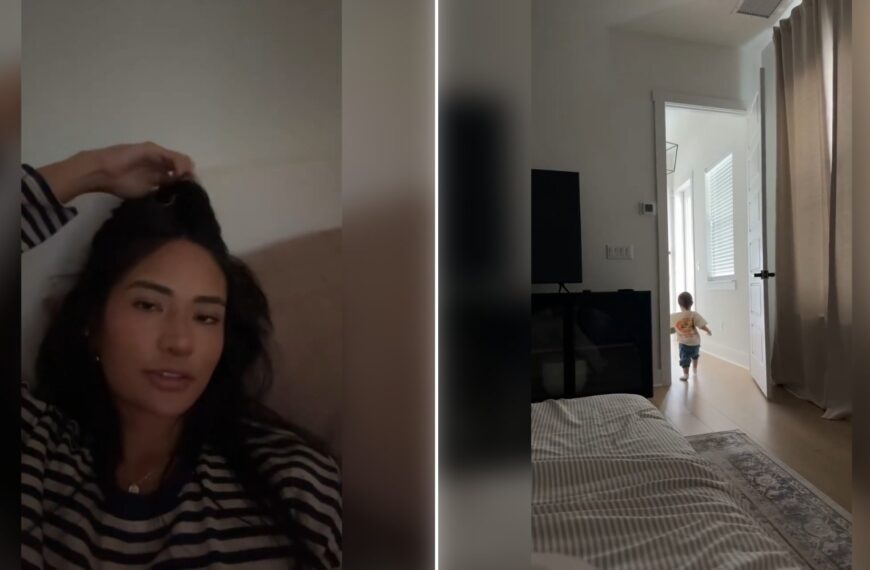
A creator posting under the handle yulia.gudimov recently posted a candid bit of parenting self-reflection built around a pretty specific double standard: her daughter barely reacts when dad raises his voice a single time, while mom, by her own admission, has been the one yelling all day and somehow gets far less of a reaction from it.
The video is filmed simply, holding her daughter close while text overlay lays out the admission plainly. There’s no defensiveness in it — just an honest, slightly funny acknowledgment that the loudest parent in the house isn’t always the one a kid reacts to the most.
Parents will recognize the pattern even without a scientific explanation for it — kids often calibrate their reactions based on how unusual something is rather than how loud it actually was. A rare raised voice from one parent can register as more jarring than routine, more frequent frustration from the other, purely because of how out of the ordinary it feels.
What makes this one worth sharing isn’t the parenting lesson so much as the honesty. Plenty of parents privately notice this exact double standard in their own homes; not many say it out loud, on camera, with a straight face.
There’s something almost confessional about the format here. Instead of presenting herself as the calm, patient parent in a highlight-reel clip, she’s pointing the camera directly at her own inconsistency, the gap between how she sees herself and how her daughter actually experiences her day to day. That kind of self-aware honesty tends to land better with an audience of other parents than any polished advice ever could, mostly because it sounds like something they’ve muttered to themselves at least once this week.
It also touches on a dynamic that shows up in a lot of two-parent households: the sense that one parent has become background noise simply by being around more often. The parent who handles the bulk of daily logistics — meals, homework, bath time, the hundred small redirections that happen before lunch even arrives — ends up delivering far more instructions, and by sheer volume, far more raised voices, than the parent who’s present for a smaller slice of the day. Kids adjust their sensitivity accordingly, not out of disrespect, but because familiarity dulls the alarm.
There’s a term some parenting circles use for this: habituation. A sound, a tone, a phrase repeated often enough simply stops registering as urgent, the same way a person who lives near a train track eventually stops hearing the trains. A single raised voice from a parent who rarely raises it, on the other hand, breaks the pattern completely, which is exactly why it gets the bigger reaction even though, by volume alone, it might have been the gentler of the two.
None of this means one parent is doing it wrong. Frustration levels don’t distribute evenly across a household just because two adults are sharing the parenting load; whoever is closer to the daily grind of naptimes, tantrums, and repeated requests to put shoes on is going to run out of patience more often, purely as a function of exposure. Recognizing that pattern out loud, the way this video does, tends to be more useful than pretending it doesn’t exist.
It’s also worth noting how quickly kids recalibrate once a pattern shifts. A parent who’s historically been the quieter, more even-keeled one doesn’t stay that way forever if life circumstances change, and kids adjust their radar accordingly within a matter of weeks. The dynamic captured in this video is a snapshot of a specific season, not a fixed household law.
What ties it together is the mom’s willingness to name the imbalance instead of just quietly resenting it. There’s comic relief in admitting out loud that you’re the louder, more frequent voice in the house, but there’s also something oddly freeing about it — a small release valve for a frustration most parents carry silently most days, dressed up here as a joke instead of a complaint.
Comment sections under videos like this one tend to fill up fast with other parents trading their own versions of the same story — the dad who’s barely home long enough to raise his voice getting treated like a folk hero for a single stern word, while mom’s hundredth request of the day barely registers. It’s less a critique of either parent and more a shared shrug at how unevenly attention gets distributed in a household, no matter how hard both people are actually working.
There’s also a generational echo worth noting here. Plenty of adults can trace this exact dynamic back to their own childhood homes, where one parent’s rare outburst became family legend while the other’s daily fatigue barely got mentioned at all. Watching it play out again, one generation later, in real time on a phone screen, is part of why videos like this resonate so widely — it’s less a new discovery than an old pattern finally being said out loud.
By the end of the clip, nothing about the household dynamic has actually changed. Dad still raises his voice rarely enough that it counts as an event; mom is still the background soundtrack of an ordinary day. But naming it plainly, without bitterness, turns a low-grade source of frustration into something a lot more bearable — and gives every other parent watching permission to laugh at the exact same imbalance playing out in their own living room.