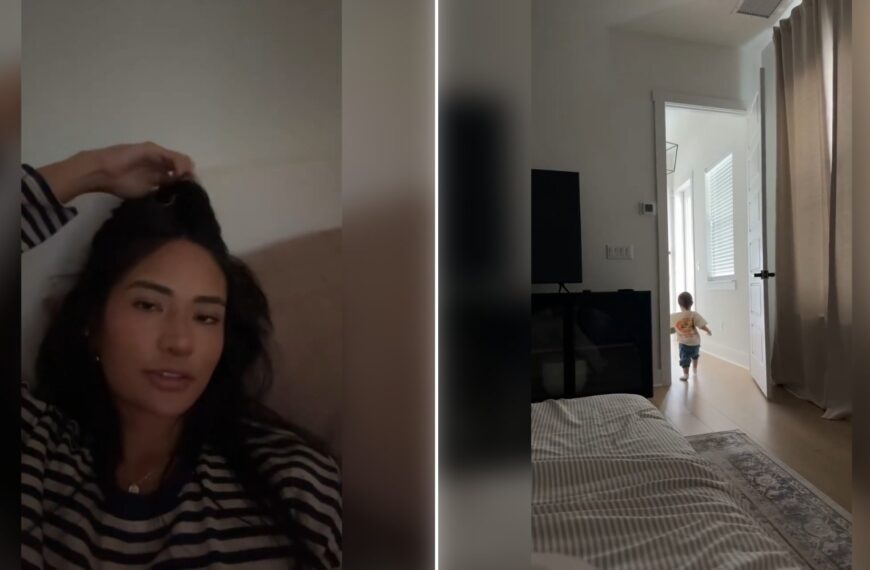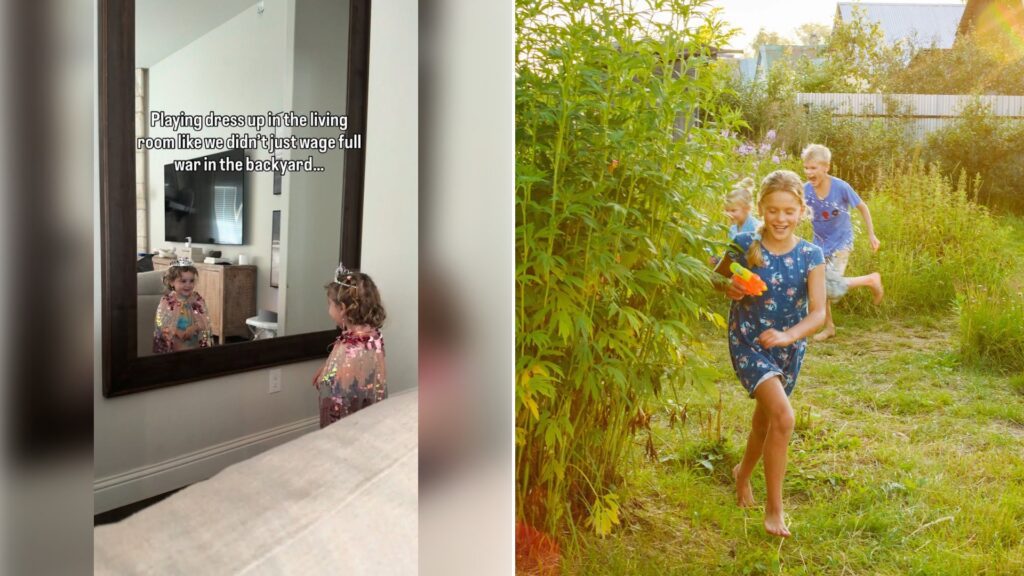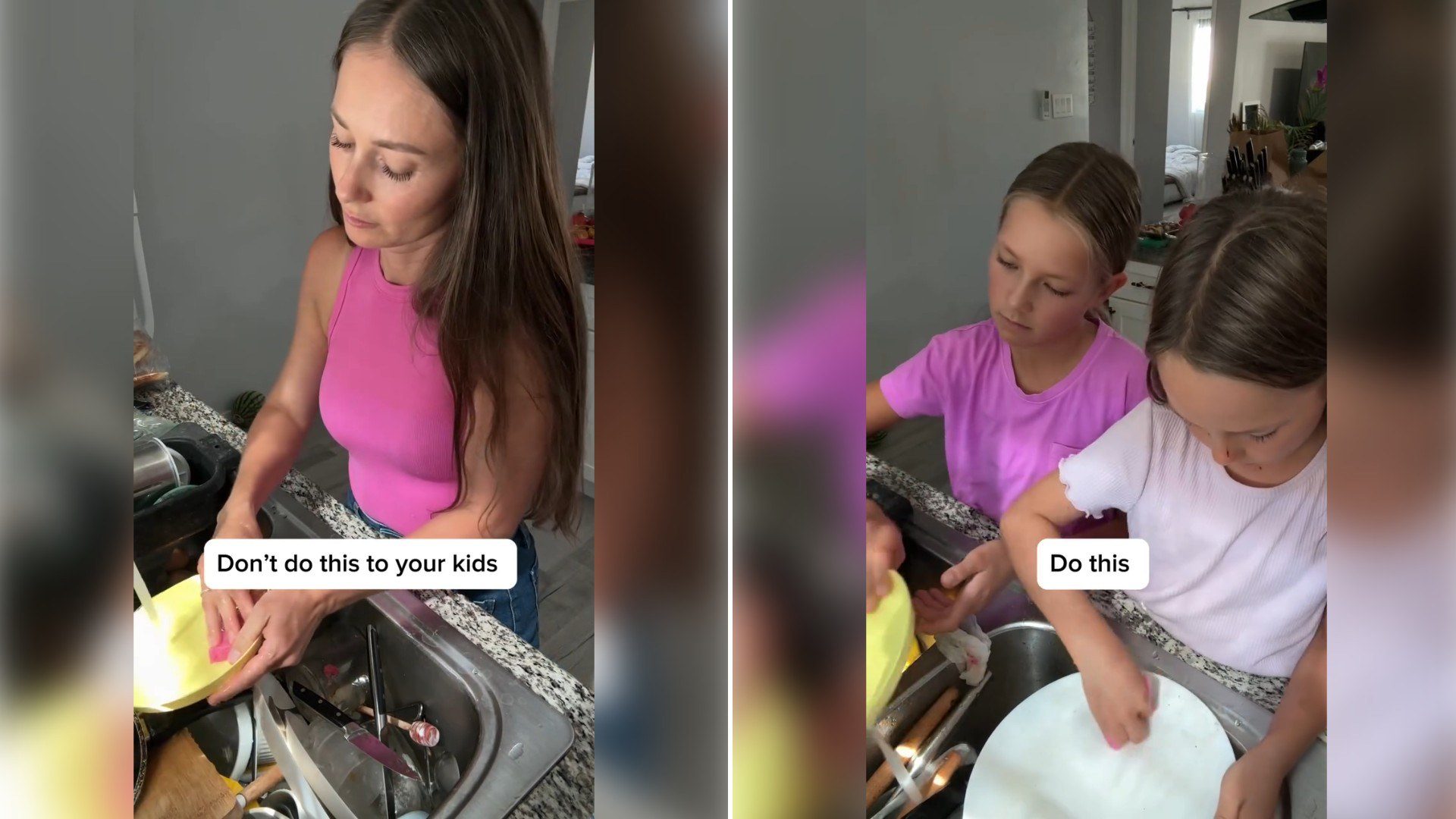
A parent posting under the handle like_funny_fam recently put two familiar household scenes side by side, and the difference between them says a lot about how chores actually get learned. In the first, she’s handling the cleanup solo while her daughters play a few feet away, uninvolved and unbothered. In the second, she brings them in on the same task, actively teaching them to help instead of working around them.
The two clips are only seconds apart, but they capture two entirely different households. One is quieter and faster, the version most parents default to on a busy weeknight when there isn’t time to supervise small hands fumbling through a task that would take thirty seconds solo. The other is louder, slower, and a little bit messier in the moment, but it’s the version that’s actually building something. Side by side like that, the contrast does more work than any caption could.
The video doesn’t frame either version as a failure. It’s presented as a real, lived contrast — the kind most parents cycle through without thinking much about it, simply because solo cleanup is often faster in the moment. But the second clip makes the case that slower, shared chore time is doing something the fast version isn’t: building the expectation, early, that housework is everyone’s job, not just mom’s.
That framing lines up with what a lot of parenting and child-development guidance already points to. Kids who are brought into chores young, even in small, imperfect ways, tend to carry that sense of shared responsibility further into adolescence than kids who are simply kept out of the way while the adults handle everything. The learning curve is real — a task almost always takes longer with a toddler “helping” — but the payoff shows up later, not immediately.
What makes this particular comparison resonate is that it isn’t scripted advice content. It reads like a parent genuinely rethinking her own default pattern in real time, which is exactly the kind of practical, non-performative parenting reflection this audience tends to respond to most.
It also taps into a specific kind of household fatigue that a lot of parents recognize but rarely say out loud: the sense that you are the only one who notices the mess, the only one who feels compelled to fix it, and the only one still standing in the kitchen after everyone else has wandered off to play. That invisible-labor feeling doesn’t start when kids become teenagers who leave dishes in the sink. It starts much earlier, in these small daily decisions about whether to hand a toddler a rag or just wipe the counter yourself because it’s faster and cleaner that way.
There’s also a sibling dynamic worth noticing in a clip like this. When one child sees another being handed a job, even something as small as matching socks or carrying a napkin to the table, it tends to normalize the idea that chores are just part of how the household runs, not a punishment reserved for one kid. Over time, that shared expectation can do more to prevent resentment between siblings than any amount of after-the-fact refereeing about who did more work.
None of this requires a rigid chore chart or a system with stickers and rewards, although plenty of families do use those tools successfully. Sometimes it’s as simple as narrating the task out loud, handing over a smaller version of the same tool the adult is using, and accepting that the counter will get streaky or the toy bin will get reorganized in a way that makes sense only to a four-year-old. The point isn’t a perfectly executed chore. It’s the repetition of being included in the first place.
Working parents in particular tend to feel the pull toward the faster, solo version of chores most acutely, simply because time is the scarcest resource in the house on a weeknight. It can feel almost irresponsible to slow down and let a task take twice as long when there’s a bedtime looming and a lunch to pack. But plenty of parents who’ve stuck with the slower version for a few years report the same thing: eventually, the kids stop needing to be asked, and the household simply runs with more hands on deck.
There’s also something to be said for how this shapes a kid’s sense of competence. A toddler who’s allowed to actually participate, badly at first, in real household tasks tends to develop a different relationship to responsibility than one who’s only ever handed toy versions of grown-up jobs. Real chores, even tiny ones, send the message that a child’s contribution matters to how the family actually functions, not just that they’re being kept entertained while the adults do the real work.
It’s worth saying, too, that the solo version of chores isn’t some parenting failure worth feeling guilty about. Every household cycles through both modes depending on the day, the deadline, and how much patience is left in the tank by 6 p.m. The value of a video like this isn’t that it shames the fast version, but that it makes the slower version feel achievable, something a tired parent might actually try tomorrow instead of just admiring from the couch.
Clips like this tend to stick with people precisely because they don’t offer a tidy five-step system. They just show two versions of an ordinary Tuesday and let the viewer decide which one they want to lean toward a little more often. For a lot of parents scrolling past it, that’s plenty of motivation to hand over the sponge next time instead of reaching for it themselves.