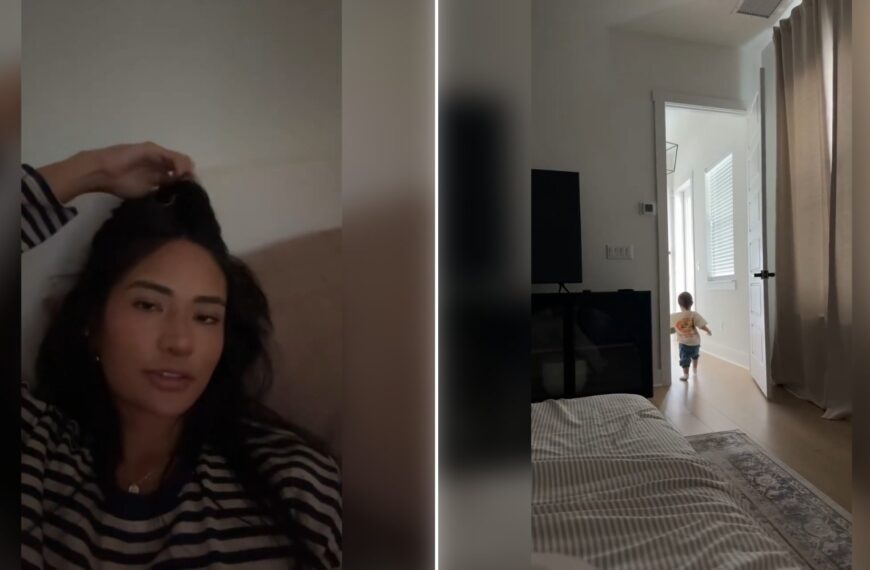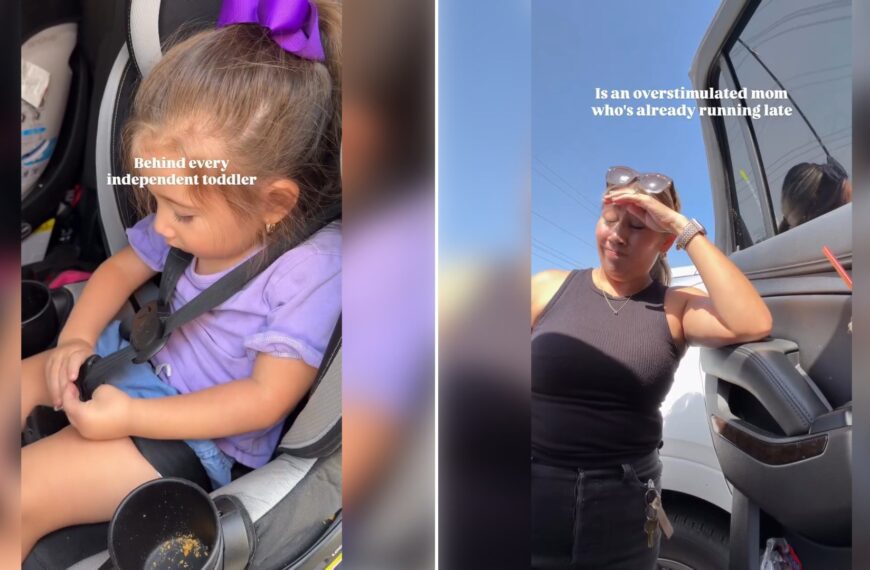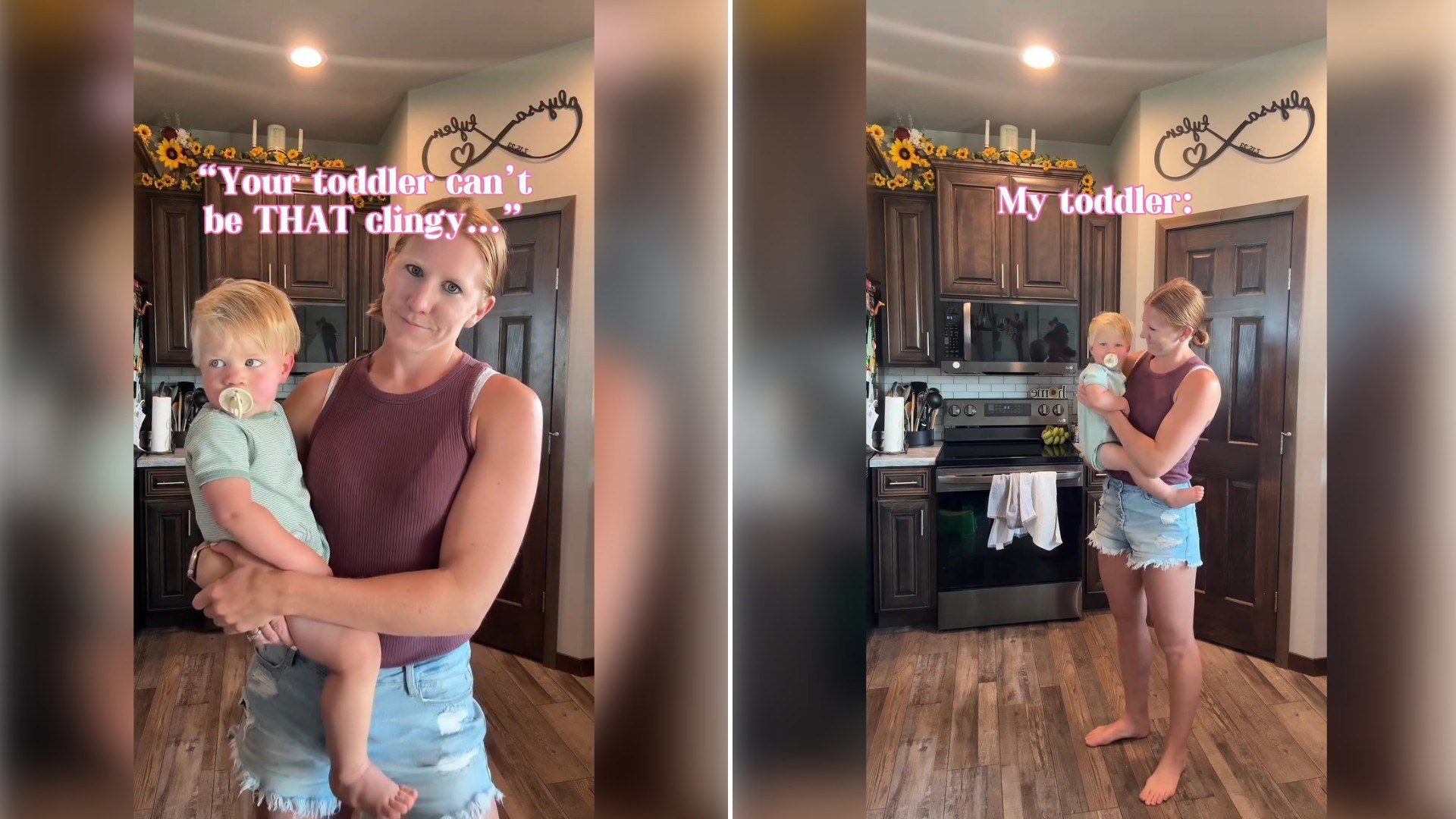
A creator posting under the handle _lifewithlyss recently captured one of the more physically literal examples of toddler attachment to hit social media lately: her daughter latched onto her arm, dangling her full body weight off it, flatly refusing to let go. Over-the-top, cinematic music plays underneath, turning an ordinary clingy moment into something closer to a dramatic short film.
The caption suggests the toddler actually didn’t want to be picked up at all in the moment — which only adds another layer to the joke. Toddlers can be simultaneously resistant to being held and completely unwilling to be put down, sometimes within the same thirty seconds, and the exaggerated soundtrack does a good job of capturing how dramatic that contradiction can feel from the parent’s side.
Physically demanding as it looks, this kind of clinginess is developmentally normal and, for most toddlers, temporary. It tends to spike around transitions — new environments, tiredness, a shift in routine — and fades as kids build more confidence operating independently. In the meantime, a little comic exaggeration, and a strong grip, go a long way toward getting through it with a sense of humor intact.
What sells the joke is the mismatch between the music and the actual stakes involved. Sweeping, orchestral, almost trailer-worthy sound design applied to a toddler refusing to detach from a forearm makes the moment feel absurdly high-drama, which is exactly the kind of gap between tone and content that tends to travel well online. It’s the same comedic trick behind countless parenting clips: take something mundane, score it like a life-or-death showdown, and let the audience fill in the punchline.
Anyone who has carried a toddler through a grocery store, a doctor’s waiting room, or just from the living room to the kitchen knows exactly how heavy dead weight can feel when a kid goes limp and refuses to cooperate with being set down. There’s a very specific ache that develops in a parent’s forearm and shoulder after enough of these standoffs, one that never quite makes it into the glossy version of parenting most people picture before they have kids.
Clinginess like this often gets treated as a problem to be solved, something to train out of a child as quickly as possible. But plenty of child-development specialists frame it differently: a toddler who clings hard to a trusted adult is, in a strange way, showing that the attachment is working exactly as intended. Secure kids test the elasticity of that bond constantly, pushing away one moment and grabbing back on the next, because they trust that the parent will still be there either way.
That doesn’t make the in-the-moment experience any less exhausting, of course. There’s a reason so many parents end up laughing about these standoffs only after the fact, usually while icing a sore bicep or rubbing a kink out of their lower back. In real time, a fully committed toddler cling can feel less like an adorable milestone and more like an impromptu strength test nobody signed up for.
It helps, too, that moments like this are almost always short-lived, even if they don’t feel that way in the thick of it. Most toddlers who go through an intensely clingy phase eventually swing the other direction, sometimes within the same year, suddenly wanting to do everything independently and rejecting help they once demanded. Parents who save clips like this one tend to be glad they did, if only as proof of just how small and stubborn their kid used to be.
There’s also something quietly relatable about choosing to laugh at a hard moment instead of just gritting through it silently. Adding a dramatic score to an arm-dangling toddler doesn’t erase the physical toll of the moment, but it reframes it into something shareable, something other parents can watch and immediately recognize from their own living rooms. That shared recognition, more than the joke itself, is usually what keeps clips like this circulating.
By the time the music swells to its biggest, most theatrical beat, the joke has already landed: this is what toddlerhood actually looks like behind closed doors, dramatic soundtrack optional but clearly deserved.
There’s a practical side to this too, one that doesn’t get talked about nearly as much as the emotional side of toddler attachment. Carrying a resisting, dangling child even for a few seconds puts real strain on a parent’s back and shoulders, and doing it repeatedly across a single day, let alone a single year, adds up in ways that quietly shape how tired parents feel by bedtime. It’s not just an emotional workout watching a toddler cling this hard; it’s a literal one too.
Part of what makes this clip so widely relatable is that almost every parent has a version of it stored somewhere on their phone, even if they never got around to adding a dramatic score. The kid refusing to be put in the cart, the one who wants to be held through an entire grocery run, the toddler who melts into a puddle of limbs the second an adult tries to set them down on solid ground — these are universal toddler moves, showing up in nearly identical form in households that have nothing else in common.
It’s also a reminder that the version of parenting worth documenting isn’t always the tidy, smiling one. The messy, physically absurd moments — the ones that leave an arm sore and a parent slightly out of breath — often make for the funniest and most honest footage, precisely because there’s no way to fake how real that kind of full-body toddler commitment actually is.